
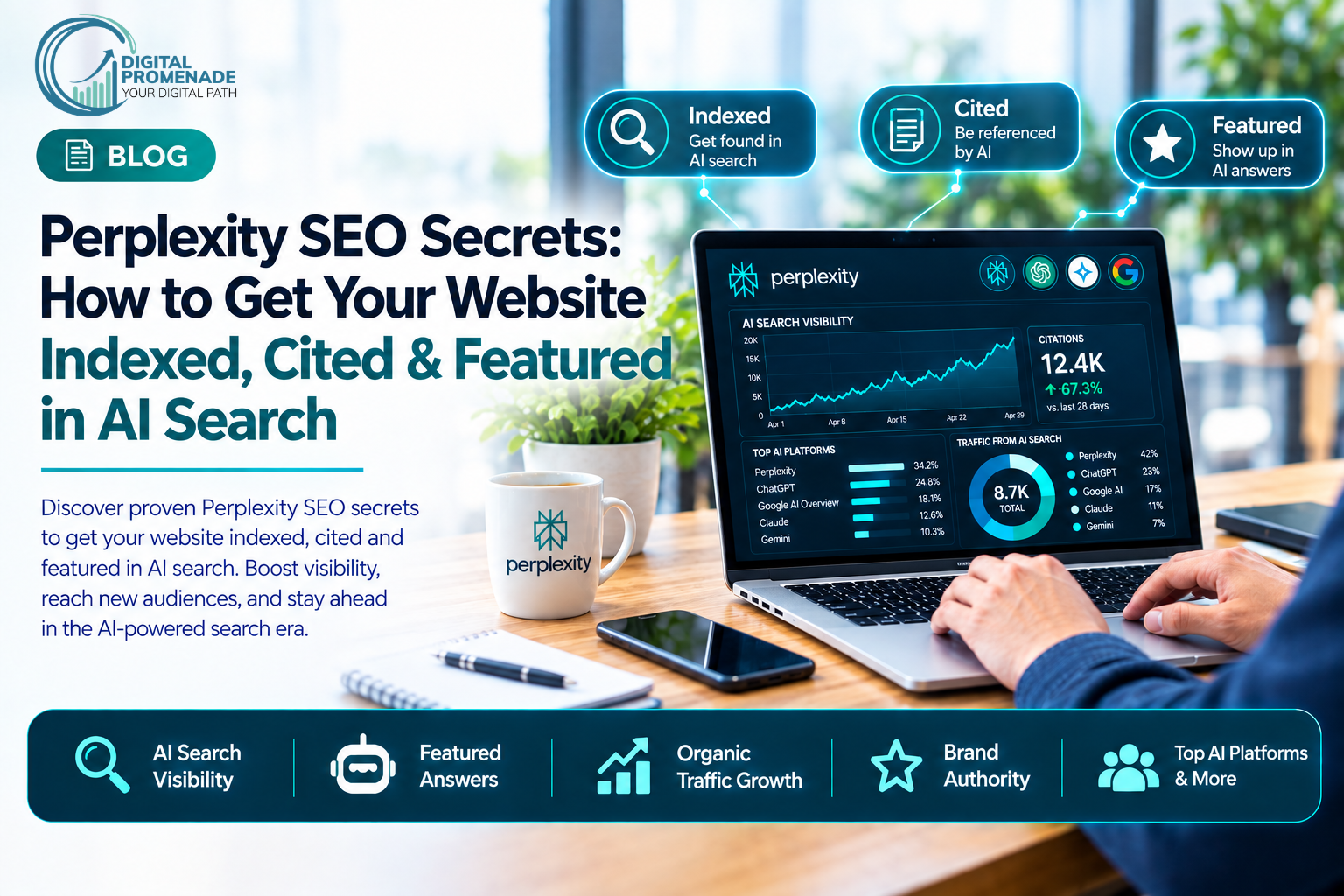
Digital Promenade Objective: Explain exactly how Perplexity indexes, ranks, and cites websites, how that differs...
Perplexity SEO Secrets: How to Get Your Website Indexed, Cited & Featured in AI Search
Digital Promenade
Objective:
Explain exactly how Perplexity indexes, ranks, and cites websites, how that differs from ranking in Google or getting picked up in ChatGPT, and the specific process we use to get client content featured across all three.
Key Takeaways
- Perplexity runs on retrieval-augmented generation, pulling roughly 10-30 candidate pages per query from its own index in real time, reranking them by authority and entity signals, then citing the strongest sources directly in the answer – it does not accept paid placements of any kind.
- Reverse-engineering studies of Perplexity’s citation behavior in 2026 put the approximate ranking-factor weights at content relevance (~30%), visual placement (~20%), domain authority (~15%), freshness (~15%), source diversity (~10%), and structured data (~10%), though these shift by query type.
- A Seer Interactive analysis of 10,000 Perplexity queries found that content containing relevant quotes, statistics, and original data saw a 40% visibility boost over content without them.
- A 2026 Ahrefs study of 863,000 keywords found only 38% of Google AI Overview citations now come from pages ranking in the traditional top 10, down from 76% in July 2025 – traditional rankings and AI citations are drifting apart fast.
- Because Perplexity retrieves content live, a page can start getting cited within one to seven days of publishing and being indexed by search engines, far faster than typical traditional ranking timelines.
- We build Perplexity and ChatGPT citation tracking into our SEO services as a best SEO company in India working across domestic and international markets.
We keep running into the same disconnect on client accounts: a page ranks fine on Google, but the exact same page never gets cited when someone asks Perplexity or ChatGPT the same question. That’s not a coincidence, and it’s not a ranking problem in the traditional sense. Perplexity retrieves and reranks content live for every query using its own index, weighing relevance, freshness, and structured data very differently than Google’s accumulated authority model. This guide breaks down exactly how that mechanism works and what to change in your content to get cited, not just ranked.
Did You Know? A 2026 Ahrefs study of 863,000 keywords found that only 38% of Google AI Overview citations now come from pages ranking in the traditional top 10 – down sharply from 76% in July 2025. Ranking on page one of Google no longer guarantees you’ll be cited in an AI-generated answer, and the gap is widening.
What Is Perplexity SEO and Why Does It Work Differently From Google?
Perplexity SEO is the practice of structuring and positioning content so Perplexity’s retrieval system selects your page as a cited source inside its AI-generated answers. Perplexity doesn’t show ten blue links the way Google does. It runs retrieval-augmented generation, pulling live candidate pages for every query, reranking them, and synthesizing a single answer with inline numbered citations pointing back to the sources it used.
This is a structurally different game from traditional SEO. Google’s algorithm leans heavily on accumulated authority signals built over years – backlinks, domain age, historical engagement data. Perplexity re-evaluates sources at the moment of the query, which means fresher, well-structured content from a smaller or newer domain can outcompete an established page that hasn’t been updated recently.
Skim summary: Perplexity SEO means optimizing to be cited inside a live, retrieval-generated answer rather than ranked on a static results page, and because Perplexity reranks sources at query time, freshness and structure can matter more than accumulated domain authority.
How Does Perplexity Actually Index, Rank, and Cite Websites?
Perplexity doesn’t index the entire web the way Google does. It maintains its own index alongside partner data sources, and for every query it retrieves roughly 10-30 candidate pages, reranks them through a multi-layer pipeline, then embeds inline citations linking each specific claim back to its source.
What Ranking Factors Does Perplexity Actually Weigh?
Reverse-engineering studies from 2026 put the approximate weighting as follows, though these shift depending on whether a query is informational or commercial.
Ranking Factor | Approximate Weight | What It Means |
Content relevance | ~30% | How precisely the page answers the specific query asked |
Visual/structural placement | ~20% | How clearly information is organized with headings and formatting |
Domain authority | ~15% | Established credibility, though weighted less than in traditional SEO |
Content freshness | ~15% | How recently the page was updated, with a recency boost applied |
Source diversity | ~10% | Whether Perplexity is citing a natural mix of sources, not over-relying on one domain |
Structured data | ~10% | Whether schema markup helps the system parse page structure |
For commercial queries specifically, trust signals and review platforms like G2, Clutch, and Trustpilot carry additional weight beyond this baseline.
Skim summary: Perplexity retrieves a small pool of candidate pages per query and reranks them using content relevance, structural clarity, domain authority, freshness, source diversity, and structured data, with commercial queries weighting trust and review signals more heavily.
How Do You Get Your Website Indexed and Cited in Perplexity?
We run the same five-step process on every account aiming for Perplexity visibility.
Step 1: Confirm Perplexity's Crawler Can Access Your Site
Before anything else, we check that Perplexity’s crawler isn’t blocked by an outdated robots.txt rule, and that pages render properly without requiring heavy JavaScript execution that a crawler might not fully process.
Step 2: Front-Load the Direct Answer
We structure content so the query gets answered within the first five to ten lines of a section, since Perplexity’s retrieval system favors content that resolves the question immediately rather than building up to it.
Step 3: Add Original Data, Quotes, or Case Studies
Content backed by original research, statistics, or named expert input gets cited more often than content that only summarizes someone else’s findings. This is one of the more consistent patterns across Perplexity citation studies in 2026.
Step 4: Add Structured Data and Clear Headings
FAQ, HowTo, and Article schema, paired with clean H2/H3 formatting, help Perplexity’s system parse exactly what a page covers and where.
Step 5: Keep the Page Fresh
Since Perplexity applies a recency boost, we schedule regular content reviews on priority pages rather than letting them sit untouched, particularly for fast-moving topics like AI search itself.
Because Perplexity retrieves content live, a properly optimized page can start getting cited within one to seven days of publishing and being indexed by search engines – far faster than the months a traditional ranking improvement typically takes.
Skim summary: Getting indexed and cited in Perplexity takes five steps – confirming crawler access, front-loading direct answers, adding original data, layering in structured data, and keeping content fresh – and citations can appear within a week of publishing, much faster than traditional SEO timelines.
How Do You Optimize Content for ChatGPT Brand Visibility Too?
ChatGPT with browsing pulls from a different retrieval mechanism than Perplexity, but the underlying content habits that work for one tend to transfer to the other. We’ve found the strongest results optimizing for ChatGPT come from the same answer-first structure and verifiable data used for Perplexity, plus comparison-style content specifically, since ChatGPT users frequently ask it to compare named options directly.
Are You Optimized for AI and ChatGPT Search?
Run a quick check: search your own brand name plus your core service inside ChatGPT and Perplexity directly and see whether your site gets cited at all. If it doesn’t, the fastest fix is usually confirming crawler accessibility first, since a blocked or JavaScript-only page can’t be cited regardless of content quality. We cover this exact diagnostic in more depth in our guide to ranking your brand in ChatGPT and Gemini.
Skim summary: ChatGPT visibility relies on many of the same fundamentals as Perplexity – answer-first structure and verifiable data – with comparison-style content performing especially well, and the fastest way to check your current status is simply asking ChatGPT about your own brand directly.
How Do You Make Your Site More AI-Citable for Brand Visibility?
Making a site AI-citable means removing the barriers that stop a model from lifting a clean, accurate claim from your page. That starts with accessibility – confirming AI crawlers can actually read your priority pages – followed by restructuring key sections so each one states a direct, specific claim rather than a vague brand statement.
Generic lines like “we’re a trusted provider” give a model nothing to cite. A specific claim like a real percentage, a documented project outcome, or a named case study gives it something concrete to lift and attribute to your brand. We build this directly into our digital marketing packages rather than treating it as a separate audit.
Skim summary: AI-citable content requires confirmed crawler accessibility plus specific, verifiable claims instead of vague brand statements, since a model can only cite what it can both read and treat as a concrete, attributable fact.
How Do You Increase Brand Mentions Across AI Platforms?
Increasing brand mentions across AI platforms comes down to consistency: the same brand facts, repeated accurately, across enough credible sources that a model builds confidence in citing you.
What Are the Top Techniques for Increasing Brand Mentions in AI Responses?
- Publish original research or data other sites will reference and link to
- Keep business information identical across your website, directories, and social profiles
- Earn press mentions and third-party citations in topic-relevant publications
- Build comparison and definition content around exactly how your target audience phrases their questions
- Update high-priority pages on a fixed schedule rather than leaving them static for years
How Do You Appear in AI Searches With Your Brand?
Appearing consistently starts with entity clarity – making sure a model has no ambiguity about who you are, what you do, and where you operate. This is the same entity-building work behind traditional Knowledge Graph visibility, and it transfers directly to how Perplexity, ChatGPT, and Gemini recognize and cite a brand.
Skim summary: Brand mentions increase across AI platforms through consistent entity information, original data other sites reference, earned press coverage, and audience-phrased comparison content – all reinforcing the same brand facts repeatedly across the web.
Is Google's AI Overview Stealing Your Clicks?
Yes, for many queries. Independent research on AI Overviews has found meaningful click-through rate declines on the position-one organic result when an AI Overview appears, and a growing share of AI Overview citations no longer come from traditional top-10 rankings at all – the Ahrefs study cited above found this share dropped from 76% to 38% in about a year. That means even businesses ranking well on Google are losing clicks to the AI Overview itself, not just to competitors.
This isn’t a reason to abandon traditional SEO. It’s a reason to treat AI citation as a parallel goal running alongside traditional rankings, not an afterthought. Our AI Overviews survival guide covers the click-through side of this shift in more depth.
Skim summary: AI Overviews are measurably reducing organic click-through rates, and the pages getting cited increasingly aren’t the same pages ranking in the traditional top 10, which means traditional rankings alone no longer guarantee visibility or clicks.
How Should You Update Existing Articles for Better AI Search Performance?
Updating an existing article for AI search performance starts with an audit, not a rewrite. We check whether the page currently gets cited anywhere, confirm crawler accessibility, then focus updates on three things: moving the direct answer earlier in each section, adding a genuine data point or original observation if the page currently has none, and refreshing the publish or updated date honestly, since Perplexity and other engines apply a real recency boost.
We run this exact audit process as part of our technical SEO audit checklist, applied specifically to AI-citation readiness rather than only traditional technical health.
Skim summary: Updating existing content for AI search performance means auditing current citation status first, then front-loading answers, adding genuine new data, and refreshing dates honestly rather than rewriting the whole page from scratch.
What Are the Best Ways to Improve AI Visibility Without Publishing Low-Value Content?
Publishing more content is not the same as publishing citable content, and flooding a site with thin, AI-generated filler tends to hurt AI visibility rather than help it, since these systems increasingly favor originality and depth over volume.
The better path is consolidating and strengthening existing content: merging thin, overlapping pages into one comprehensive resource, adding original data or a genuine case study to a page that currently only summarizes general knowledge, and improving structure on pages that already rank but aren’t structured for extraction. We’d rather improve twenty existing pages this way than publish two hundred new low-value ones.
Skim summary: Improving AI visibility without adding low-value content means strengthening what already exists – consolidating thin pages, adding original data, and restructuring for extraction – rather than increasing publishing volume alone.
How Do You Track AI Mentions and Measure Brand Visibility Credibly?
Measuring AI visibility credibly requires actual citation data, not assumptions based on traditional rank tracking, since the two increasingly diverge.
How Do You Track Mentions in AI Overviews Continuously?
We use dedicated AI-visibility trackers alongside manual spot-checks across ChatGPT, Perplexity, and Google AI Overviews for a client’s core queries, monitored on a monthly cadence through our AI agents for SEO automation rather than a one-time check.
How Do You Measure Your Brand's Visibility in AI Assistants Like ChatGPT Credibly?
Credible measurement means tracking three things together: citation frequency for a defined set of target queries, share of citations relative to named competitors on the same queries, and whether citations are trending up or down over time. A single screenshot of one good result isn’t measurement – a repeatable, defined query set tracked monthly is.
Skim summary: Credible AI visibility measurement means tracking citation frequency, competitive share of citations, and trend direction across a defined query set monthly, not relying on a single favorable screenshot or assuming traditional rank data tells the same story.
How Do You Measure Your Brand's Visibility in AI Assistants Like ChatGPT Credibly?
We built this scorecard from the questions we wish more clients had asked us before hiring a previous vendor. Rate any SEO company on each point, out of 5.
Criteria | What to Check | Score out of 5 |
Perplexity-specific knowledge | Do they understand Perplexity’s retrieval model, not just general “AI SEO”? | — |
Citation tracking | Can they show current citation data across ChatGPT, Perplexity, and AI Overviews? | — |
Content structuring process | Do they front-load answers and add original data, not just keyword-stuff? | — |
Freshness management | Do they schedule regular content updates, not just publish and forget? | — |
Transparent reporting | Do they separate traditional ranking data from AI citation data clearly? | — |
A genuine best SEO company – whether searching for a best SEO company UK, best SEO company USA, or a best SEO company in India – should score well across all five without hesitation. We score ourselves honestly too: 5/5 on Perplexity-specific knowledge and citation tracking since that’s core to how we operate, 5/5 on freshness management, and 4/5 on transparent reporting on very new accounts where baseline AI citation data is still being gathered in month one.
Skim summary: Score any SEO company on Perplexity-specific knowledge, citation tracking, content structuring, freshness management, and transparent reporting – an honest provider will walk you through each point with live examples.
Our Process for Getting Clients Cited in Perplexity and AI Search
We treat Perplexity and AI citation tracking as a core part of every SEO engagement, not a separate premium add-on. On a recent project for a client offering SEO services India alongside broader digital marketing, we audited their top service pages and found several answered questions three or four paragraphs in, instead of upfront. Restructuring those pages to answer directly within the first few lines, adding a documented case study to each, and refreshing outdated statistics got two of the pages cited in Perplexity answers within about ten days of republishing.
We also work with clients who came to us first as a website development company in Noida and later added SEO once their new site was live, since a technically clean, fast-loading site is one of the easier wins for AI crawler accessibility from day one. Businesses searching for the best website development company in Noida or the best digital marketing company overall tend to get the most value from combining both under one roof rather than hiring separately. Read more about how we became a top SEO company in India for the fuller story behind our process.
Skim summary: We build Perplexity and AI citation work into every SEO engagement, and restructuring client pages to answer directly within the first few lines got two pages cited in Perplexity within about ten days of republishing.
Common Mistakes That Keep Brands Out of Perplexity and AI Search
- Assuming a strong Google ranking automatically means AI citation, when the two are measurably diverging
- Burying the direct answer several paragraphs into a page instead of stating it upfront
- Publishing large volumes of thin, low-value content instead of strengthening existing pages
- Leaving high-priority content untouched for years, missing Perplexity’s recency boost entirely
- Never checking actual citation data, relying only on traditional rank tracking to judge AI visibility
Skim summary: The most common mistakes are assuming Google rankings guarantee AI citations, burying direct answers, prioritizing content volume over depth, ignoring freshness, and never actually checking citation data to know where you stand.
Ready to Get Cited, Not Just Ranked?
We build Perplexity, ChatGPT, and AI Overview citation tracking directly into our SEO services, ranked among the best SEO services available for AI-era visibility, backed by our own local SEO strategy work for location-based visibility and our AI SEO agency checklist so you know exactly what to expect before signing anything.
FAQs About Perplexity SEO and AI Search Visibility
Confirm AI crawlers can access your priority pages, restructure content to answer directly within the first few lines, and back claims with original data or named case studies. We've seen accessibility fixes alone produce faster visibility gains than months of additional content production.
Treat it as an ongoing three-part effort - accessibility, content structure, and off-site credibility - tracked monthly rather than a one-time project. Businesses that check this quarterly at most tend to fall behind competitors who monitor citation data continuously.
Structure content around the exact comparison or question a buyer would type into ChatGPT and answer it directly in the opening sentence. On one client project, rewriting a generic service page into a specific, data-backed comparison page got it cited in ChatGPT within about six weeks.
Confirm crawler accessibility first, then replace vague brand statements with specific, verifiable claims a model can lift and attribute confidently. This single change tends to matter more than adding additional pages of generic content.
There's no traditional ranking in ChatGPT the way there is on Google, but consistent citation comes from answer-first structure, verifiable data, and content that directly matches how users phrase comparison and how-to questions.
Publish original research, keep business information consistent across every platform, and earn genuine press or third-party mentions. Repetition of the same accurate facts across credible sources is what builds a model's confidence in citing a brand.
Use a dedicated AI-visibility tracker alongside manual spot-checks on a defined set of target queries, monitored monthly rather than occasionally. A one-time check tells you almost nothing about a trend that changes as your content and competitors' content both evolve.
Yes, for many query types, and a growing share of AI Overview citations now come from pages outside the traditional top 10, meaning even strong Google rankings don't fully protect click-through rates anymore.
Audit current citation status first, then front-load the direct answer, add a genuine new data point, and refresh the update date honestly rather than rewriting the whole page. Small, targeted updates to existing high-value pages tend to outperform publishing new thin content.
Consolidate thin, overlapping pages into stronger resources, add original data to pages that currently only summarize general knowledge, and restructure existing high-traffic pages for extraction rather than adding publishing volume.
Track citation frequency across a defined query set, your share of citations relative to named competitors, and the trend direction over time, monitored monthly. A single good result on one query is not credible measurement on its own.
Know Your Digital Goals
Digital Promenade Objective: Break down what Answer Engine Optimization (AEO) actually involves, how to evaluate...

Digital Promenade Objective: Explain what an AI SEO agency actually does differently from a traditional...

Digital Promenade Objective: Explain what AI-ready content actually is, how AI search engines like Google...

Digital Promenade Most “best SEO company in India” lists are built the same broken way...
Digital Promenade Your online reputation is not what you say about your business – it...
Digital Promenade Ecommerce SEO wins or fails on three things: how easily search engines and...
Digital Promenade Objective This guide shows doctors and medical practices how to build a structured...

Digital Promenade Objective: Explain why running SEO and paid ads as two separate budgets wastes...
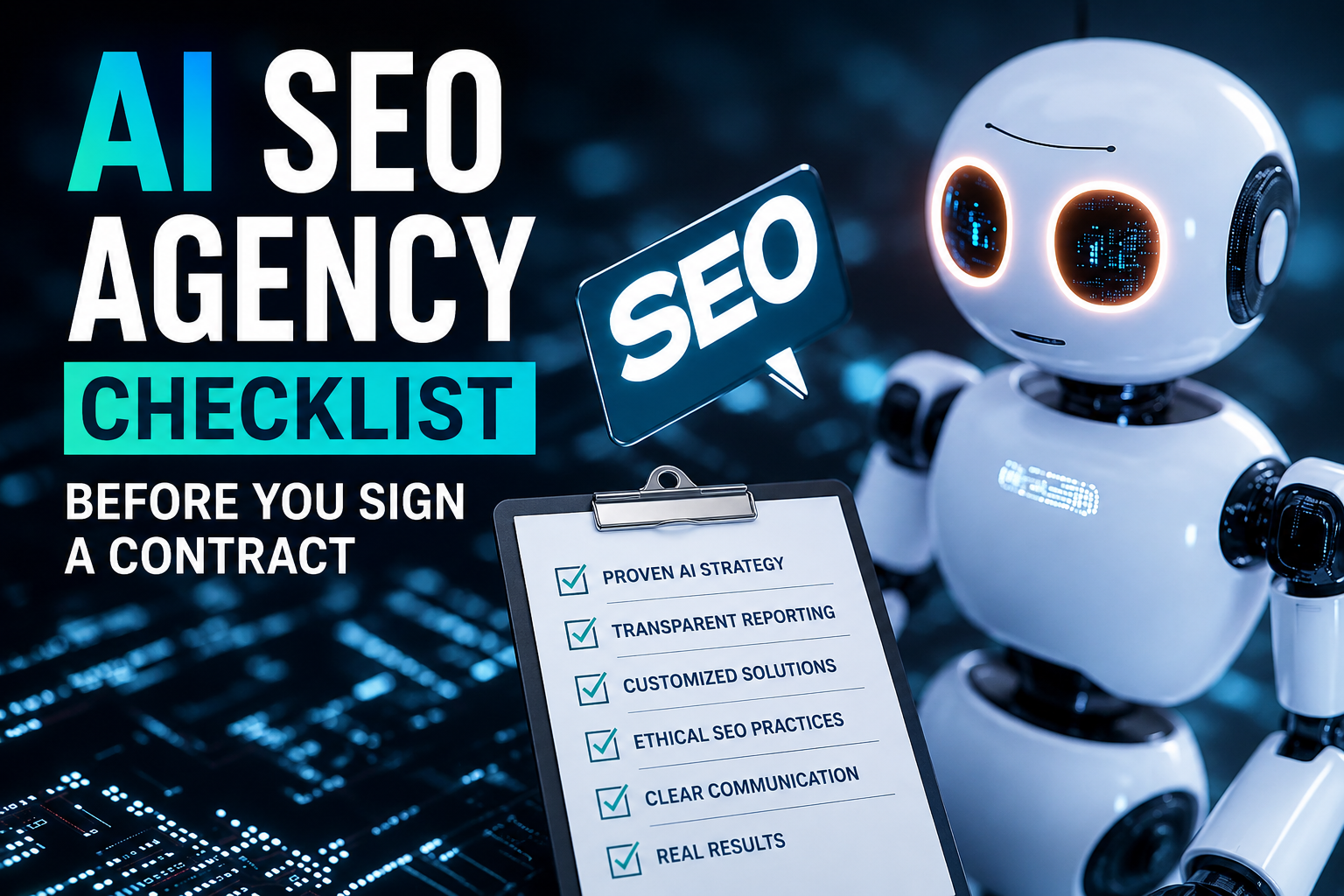
Digital Promenade Objective This post breaks down what actually separates a next-gen AI SEO agency...