
Digital Promenade Objective: Explain exactly how Perplexity indexes, ranks, and cites websites, how that differs...
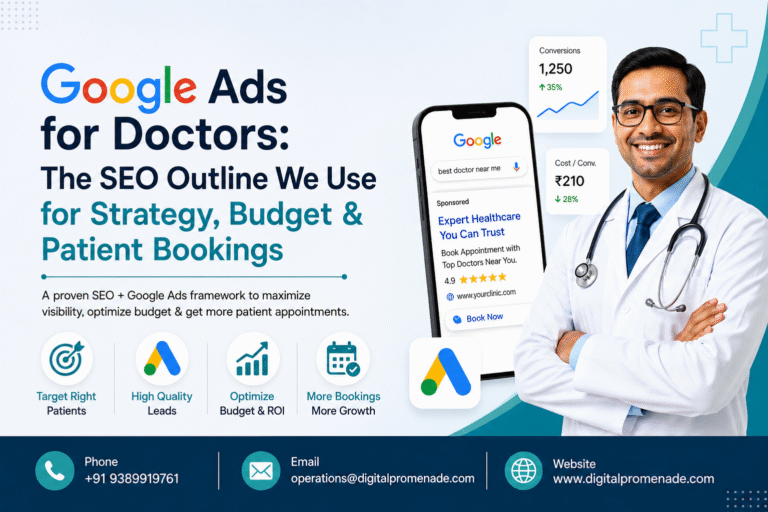
Google Ads for Doctors: The SEO Outline We Use for Strategy, Budget & Patient Bookings
Digital Promenade
Objective
This guide shows doctors and medical practices how to build a structured Google Ads for doctors SEO outline – covering strategy, budget, keyword targeting, and agency selection – so every rupee spent on ads turns into a booked appointment instead of a wasted click.
A clear Google Ads for doctors SEO outline is the difference between an account that books patients every month and one that quietly burns budget with nothing to show for it. This is exactly how we build one at Digital Promenade.
TL;DR: A Google Ads for doctors SEO outline defines your objectives, keyword strategy, budget, landing pages, and conversion tracking before a single ad goes live. Get this right and you get predictable patient bookings. Skip it and you lose patients – and money – to competitors who didn’t.
Key Takeaways
- A documented Google Ads for doctors SEO outline is necessary to avoid wasted spend and get consistent patient bookings.
- Targeting high-intent, location-based keywords brings in patients who are ready to book, not just browse.
- Smart budget planning and the right bidding strategy control costs and protect ROI.
- Optimized landing pages and accurate, HIPAA-aware conversion tracking are what actually turn clicks into appointments.
- Choosing a healthcare-experienced Google Ads agency reduces costly mistakes and speeds up results.
What Is a Google Ads for Doctors SEO Outline?
A Google Ads for doctors SEO outline is a structured roadmap that plans every part of a practice’s paid advertising strategy – keyword research, ad copy, landing pages, conversion tracking, and bidding – before the campaign goes live. Think of it as the blueprint we build for every medical client before we spend a single dollar of their budget.
Why Doctors Need SEO and Paid Ads Working Together
A lot of practices run Google Ads for doctors and medical practices without aligning the campaign with their organic SEO. That creates a disconnect: the ad says one thing, the website ranks for something else, and Quality Score suffers along with it. When paid and organic work together, a practice shows up twice on the same results page – once in the ads, once in organic search results – and that dual visibility builds patient trust faster than either channel alone.
For example, a clinic running Google Ads for naturopathic doctors should also have its site optimized around the same terms through ongoing local SEO work. Both the ad Quality Score and the organic ranking improve together.
Skimmable summary: A Google Ads for doctors SEO outline is the pre-launch roadmap covering keywords, ad copy, landing pages, and tracking – and it works best when it’s built alongside organic SEO rather than in isolation.
How Do We Plan a Google Ads Strategy for Doctors and Medical Practices?
Every account we build starts with the same five-part framework.
1. Define Patient Acquisition Goals
Before we launch anything, we set a measurable target – new patients per month, cost per appointment, or a specific revenue goal the ad spend needs to support.
- Set measurable booking targets: A number like “50 new patients a month” keeps the entire campaign focused.
- Control cost per appointment: We set a target CPA (for example, under $30 per booking) so cost stays predictable.
- Align spend with revenue goals: Ad spend should map directly to the practice’s growth targets, not sit as a disconnected expense.
- Review monthly: We check performance every month and adjust for seasonal demand and conversion trends.
2. Conduct High-Intent Keyword Research
Ads without proper keyword research waste money fast. We prioritize keywords that show a patient is ready to book, not just researching a condition.
- Target high-intent keywords: Phrases like “cardiologist near me accepting new patients” bring in visitors ready to act.
- Use location-based keywords: Adding “[city] doctor” or neighborhood modifiers sharpens visibility exactly where patients are searching.
- Add specialty-specific terms: Google Ads for naturopathic doctors, for instance, should target phrases like “natural medicine near me” or “holistic health doctor.”
- Refine with negative keywords: Excluding irrelevant searches protects budget and improves ROI from day one.
3. Build High-Converting Landing Pages
An ad with no matching landing page is money left on the table. Message match and trust signals are what convert a click into a booking.
- Match ad and headline: The landing page headline should describe the exact service promised in the ad.
- Add a simple booking form: Fewer fields mean fewer patients abandoning the request halfway through.
- Display trust signals: Reviews, certifications, and board credentials build credibility instantly – the same signals we help clients strengthen through online reputation management.
- Use a strong call to action: A direct line like “Book Your Appointment Today” consistently outperforms vague CTAs.
4. Write Ad Copy That Speaks to Patients
Medical PPC copy has to address a patient’s concern directly and create appropriate urgency without overpromising results.
- Speak to the patient’s concern: Lines like “Same-Day Appointments Available” perform better than generic service descriptions.
- Use credibility words: Terms like “board-certified,” “trusted,” and “same-day” increase click-through rate.
- Highlight outcomes, not just services: Patients respond to what they’ll gain, not a list of procedures.
- Keep it concise: Every word should support the overall medical PPC strategy, not dilute it.
5. Set Up Conversion Tracking
Without tracking, every optimization decision is a guess. We track every meaningful action a patient takes.
- Track form submissions: Completed booking forms are the clearest ROI signal.
- Monitor phone call conversions: Call tracking is essential for practices where patients prefer to call directly.
- Track live chat interactions: This captures leads that form tracking alone would miss.
- Optimize continuously: Tracking data feeds directly back into bid and budget decisions.
Skimmable summary: Our Google Ads strategy for doctors moves through five stages – clear goals, high-intent keyword research, matched landing pages, patient-focused ad copy, and full conversion tracking – with each stage feeding data into the next.
What Results Should Doctors Expect From Google Ads?
Results vary by specialty, city competition, and how disciplined the account structure is, so we don’t promise a fixed number to every practice. What we do see consistently across well-structured healthcare accounts: cost per lead drops sharply in the first 30–60 days once negative keywords are refined and landing pages are matched to ad intent, click-through rate improves as ad copy is tightened around patient pain points, and cost per conversion continues to fall as the account gathers enough data for smart bidding to take over. If you want to see what this looks like for your specific specialty and city, our PPC and lead generation team can walk you through a realistic first-90-day projection.
Skimmable summary: Well-structured medical Google Ads accounts typically see cost per lead fall and conversion rate rise within the first 60–90 days as negative keywords, landing pages, and bidding data mature – exact numbers depend on specialty and market.
How Much Should Doctors Spend on Google Ads?
Budget for Google Ads for doctors and medical practices depends on specialty, competition, and location. Smart allocation protects ROI while keeping campaigns visible enough to compete.
Specialty | Typical CPC Range | Competition Level |
General / family practice | $2 – $6 | Moderate |
Dental (general) | $3 – $8 | High |
Cosmetic dermatology | $6 – $15 | Very high |
Physiotherapy / chiropractic | $2 – $5 | Moderate |
Orthodontics | $5 – $12 | High |
Naturopathic / wellness | $2 – $7 | Moderate |
Emergency / urgent care | $4 – $9 | High |
We always recommend starting with a smaller test budget and scaling once we know which keywords and ad groups convert. Our Google Ads management services are built around this test-then-scale approach so budget never gets locked into underperforming campaigns.
Smart Bidding Strategies for Medical Ads
Smart bidding lets Google’s AI adjust bids in real time based on who is most likely to convert. We sequence three strategies depending on account maturity:
- Target CPA: Sets bids automatically to hit a target cost per appointment – ideal once there’s enough conversion history to guide the algorithm.
- Maximize Conversions: Uses the full budget to generate as many appointments as possible – best once conversion data is stable and the goal is to scale volume.
- Enhanced CPC: Makes smaller, safer bid adjustments based on conversion likelihood – the right starting point for new accounts with limited data.
Skimmable summary: Google Ads cost for doctors typically ranges from $2 to $15 per click depending on specialty, and the right bidding strategy shifts from Enhanced CPC early on to Target CPA and eventually Maximize Conversions as the account collects more data.
Is Google Ads HIPAA Compliant for Medical Practices?
Direct answer: Not by default. Google does not sign a Business Associate Agreement (BAA) for standard Google Ads accounts, so out-of-the-box conversion tracking is not HIPAA compliant if any protected health information passes through it.
According to the U.S. Department of Health & Human Services, HIPAA’s safeguards apply regardless of which advertising platform is used, and violations can carry significant penalties. In practice, we keep every medical Google Ads account compliant by avoiding PHI in URL parameters and forms, using server-side or offline conversion imports instead of raw client-side tracking, and never building remarketing audiences from patient condition data. This same discipline carries over into how we handle Google My Business optimization and other patient-facing channels.
Skimmable summary: Google Ads is not HIPAA compliant by default since Google won’t sign a BAA. Compliance comes from how the account is configured – keeping PHI out of tracking, using server-side conversion imports, and avoiding condition-based remarketing.
What Common Google Ads Mistakes Do Doctors and Medical Practices Make?
We see the same avoidable mistakes across almost every medical account we audit.
Targeting too broad an audience. Running Google Ads for doctors’ offices without tight location targeting burns budget fast – every campaign should include city or ZIP-level targeting.
Skipping negative keywords. A cardiologist who doesn’t exclude terms like “pet” or “veterinary” is paying for irrelevant clicks every single day.
Ignoring ad extensions. Sitelinks and location extensions are free, yet skipping them makes ads less visible and less clickable.
Not optimizing for mobile. The majority of healthcare searches happen on phones, so a slow or hard-to-tap landing page kills conversions before they start.
Weak landing page content. Generic, thin landing pages destroy conversion rate optimization efforts – patients need content that speaks directly to their concern, which is why we pair every ad account with dedicated SEO content support.
Skimmable summary: The costliest Google Ads mistakes for doctors are broad, untargeted audiences, missing negative keywords, ignored ad extensions, poor mobile experience, and thin landing page content – all fixable before a campaign ever goes live.
How Do We Choose the Right Google Ads Agency for a Practice?
Not every advertising company understands healthcare marketing, so before recommending an agency relationship to any client, we tell them to look for the same things we hold ourselves to:
- Healthcare experience: Real case studies from medical clients, not just general PPC results.
- HIPAA awareness: A clear, specific answer for how patient data is protected in tracking and remarketing.
- Transparent reporting: Monthly performance reports that show real numbers, not vanity metrics.
- Full-service capability: An agency offering PPC, SEO, and content together, so paid and organic aren’t working against each other.
- Google Partner status: A signal the agency meets Google’s own performance standards.
Questions Worth Asking Before You Hire
Has the agency worked with a medical practice before? How do they keep ad tracking HIPAA-aware? What’s their plan for maximizing ROI in the first 90 days? Can they manage Google Ads end-to-end – research, copy, landing pages, and reporting – under one roof, or are you coordinating three vendors?
Skimmable summary: The right Google Ads agency for doctors has real healthcare case studies, a clear HIPAA-aware tracking process, transparent reporting, and full-service capability spanning PPC, SEO, and content.
Why Work With Digital Promenade for Google Ads Management?
Building Google Ads for doctors that actually book patients takes more than setting a budget and writing a few ads. It takes a documented Google Ads for doctors SEO outline, disciplined keyword targeting, landing pages built to convert, and ongoing optimization – which is exactly what our team handles for every medical client.
Our Google Ads management services cover keyword research, ad copy, landing page guidance, and HIPAA-aware conversion tracking under one roof, backed by local SEO and Google My Business optimization so paid and organic visibility grow together. If your practice is ready to stop guessing and start booking predictable appointments, get in touch with our team or explore our packages to see where your budget fits.
FAQs About Google Ads for Doctors
Costs vary by specialty and city competition, with most practices investing between roughly $1,000 and $8,000 a month. We usually recommend starting smaller - think of it like a new clinic testing a soft-launch schedule before opening at full capacity - and scaling the budget only into what's already converting.
Yes, when the account is properly structured. With strong keyword targeting, matched landing pages, and real conversion tracking, we've consistently seen practices move from sporadic inquiries to a predictable monthly flow of booked appointments.
The strongest approach combines high-intent keyword research, tight local geo-targeting, ad copy built around patient concerns, and landing pages that match the ad exactly - then lets performance data guide ongoing bid and budget adjustments.
Radius or ZIP-code targeting keeps ads within the practice's actual service area, and adding city-specific keywords plus location extensions sharpens relevance further - similar to how we approach local SEO optimization for the same practices.
Yes. These campaigns work best around educational, trust-building messaging and terms like "holistic doctor near me," paired with clear descriptions of the specific services offered.
You can manage it yourself, but an experienced healthcare agency reduces costly setup mistakes, keeps tracking HIPAA-aware, and typically improves Quality Score and cost efficiency faster than a self-managed account.
Focus on high-intent, location-based phrases like "same-day doctor appointment [city]" or "best pediatrician near me," and avoid broad, generic terms that attract researchers instead of patients ready to book.
Not by default - Google doesn't sign a BAA. Compliance depends on how the account is configured: avoiding PHI in ads and URLs, using secure landing pages, and setting up conversion tracking that doesn't transmit patient data.
Many practices see initial inquiries within one to two weeks, but consistent optimization over 60 to 90 days is what typically stabilizes cost per lead and delivers predictable ROI.
Google Ads delivers immediate visibility through paid placement, while SEO builds long-term organic rankings that reduce dependence on ad spend over time. Running both together maximizes search visibility and builds patient trust faster than either channel alone.
Know Your Digital Goals

Digital Promenade Objective: Break down what Answer Engine Optimization (AEO) actually involves, how to evaluate...

Digital Promenade Objective: Explain what an AI SEO agency actually does differently from a traditional...

Digital Promenade Objective: Explain what AI-ready content actually is, how AI search engines like Google...

Digital Promenade Most “best SEO company in India” lists are built the same broken way...

Digital Promenade Your online reputation is not what you say about your business – it...

Digital Promenade Ecommerce SEO wins or fails on three things: how easily search engines and...
Digital Promenade Objective This guide shows doctors and medical practices how to build a structured...

Digital Promenade Objective: Explain why running SEO and paid ads as two separate budgets wastes...

Digital Promenade Objective This post breaks down what actually separates a next-gen AI SEO agency...