
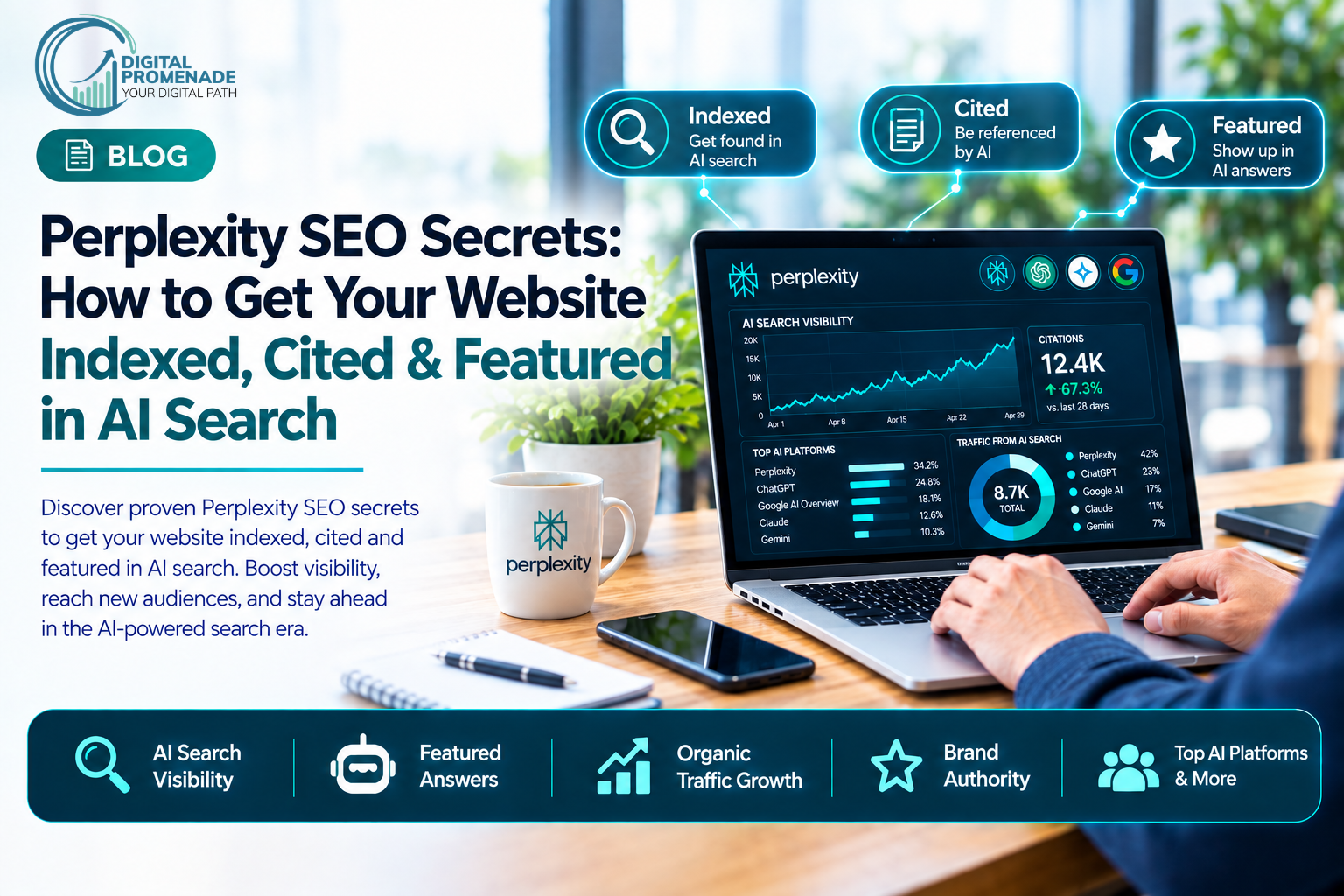
Digital Promenade Objective: Explain exactly how Perplexity indexes, ranks, and cites websites, how that differs...
How to Get Cited in ChatGPT, Perplexity & Google AI Overviews: The Complete GEO Checklist
Digital Promenade
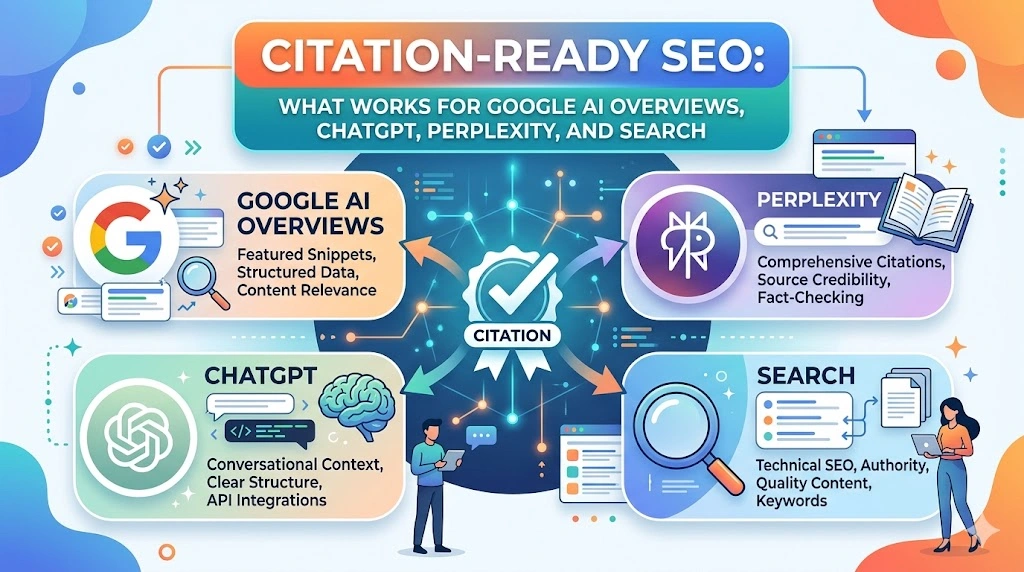
Objective
To get cited in ChatGPT, Perplexity, and Google AI Overviews, build consistent brand entity signals across the web, implement Organization and FAQPage schema, format content with direct answers near the top, earn citations from authoritative third-party sources, and make every claim specific and verifiable rather than vague marketing language.
Key Takeaways
- AI platforms cite brands based on entity clarity, structured data, and verifiable specifics – not keyword density or domain age alone.
- The same questions people ask Google as “People Also Ask” are often the exact prompts they type into ChatGPT and Perplexity, so question-based content serves both.
- FAQ-formatted pages, concise direct answers, and properly implemented schema are the fastest, highest-leverage changes most businesses can make this month.
- GEO doesn’t replace SEO – it sharpens the same foundation (technical accessibility, authoritative content, external citations) toward a different output: being named in a generated answer, not just ranked in a list of links.
- Monitoring what AI platforms currently say about your brand is the necessary first step, because you can’t fix a citation gap you haven’t identified.
Introduction
Somewhere this week, someone asked ChatGPT, Perplexity, or Google’s AI Overview a question your business could answer. Maybe they asked for the best service provider in your category. Maybe they asked a question you’ve already answered in a blog post sitting on page one of your site. The only thing that matters now is whether your brand showed up in that generated answer – or whether a competitor did.
This is the practical core of Generative Engine Optimization, or GEO: making sure AI systems have enough signal, structure, and verifiable detail to confidently mention your brand when someone asks a relevant question. It sounds like a new discipline, and in some ways it is, but it isn’t mysterious. Below is a complete, actionable checklist – built around the exact questions people are asking about this topic across Google, ChatGPT, Perplexity, Gemini, and Claude.
What Is GEO and Why Does It Matter Now?
GEO stands for Generative Engine Optimization – the practice of structuring your content, brand presence, and technical foundation so AI-powered platforms cite, recommend, or summarize your business accurately. Where traditional SEO optimizes for a ranked list of links, GEO optimizes for being named inside a synthesized answer.
This matters because the way people search has genuinely shifted. A growing share of research, comparison shopping, and decision-making now happens through a single AI-generated response rather than ten blue links a person has to click through themselves. If your brand isn’t part of that response, you’re not just missing traffic – you’re missing the moment someone is actively deciding who to trust.
How Is GEO Different From Traditional SEO?
Traditional SEO ranks pages using signals accumulated over time: backlinks, on-page relevance, technical health, and user engagement. The output is a ranked list the searcher evaluates themselves.
GEO operates on a similar technical foundation but optimizes for a different output. AI platforms read across multiple sources, synthesize an answer, and decide which brands are worth naming in that synthesis. A page can rank reasonably well on Google without ever being mentioned by an AI model, because ranking and citation-worthiness aren’t governed by identical criteria. AI systems weigh clarity, verifiability, and cross-source consistency more heavily – can the model tell exactly what you do, is that claim corroborated elsewhere, and does your own site say the same thing consistently?
How Do AI Platforms Actually Decide What to Cite?
What Does Google AI Overview Look For?
Google’s AI Overview draws heavily from pages that already perform well in traditional search, combined with structured data and content that directly answers the query without unnecessary preamble. Pages with clear headings, FAQ schema, and a direct answer in the first few sentences of a section are more likely to be pulled into the synthesized summary.
What Does ChatGPT Prioritize When Citing Sources?
When ChatGPT browses or cites external sources, it favors content that reads as authoritative and specific – named statistics, clear attribution, and unambiguous claims. Generic marketing language (“we are the best in the industry”) gives the model nothing concrete to repeat confidently. A specific claim (“clients saw an average 34% increase in qualified leads within 90 days”) is far more citable.
How Does Perplexity Choose What to Reference?
Perplexity is explicitly built around real-time citation, which means it leans on source credibility and topical relevance more visibly than other platforms – you can literally see which sources it pulled from. This makes earning a few genuinely authoritative external mentions disproportionately valuable, since Perplexity often displays the source list directly to the user.
What Matters to Gemini and Claude?
Gemini, being deeply integrated with Google’s broader search and Knowledge Graph infrastructure, weighs entity consistency heavily – the same brand name, the same described services, the same details appearing in multiple verified places. Claude, when given web access or documents, similarly favors well-structured, clearly attributed content over dense, unstructured marketing copy.
What Does Bing Copilot Do Differently?
Bing Copilot draws from Bing’s index and tends to favor pages with strong on-page SEO fundamentals already in place – meaning a site that hasn’t invested in traditional SEO basics is starting from a weaker position for AI citation too. The overlap between “good for Bing Copilot” and “good for traditional SEO” is significant.
The Complete GEO Checklist
1. Establish Your Brand as a Clear, Consistent Entity
- Use the exact same brand name everywhere – your website, social profiles, directories, and press mentions
- Claim or build out a Wikidata entry if your brand genuinely qualifies
- Implement Organization schema markup correctly on your homepage
- Write an “About” page that states specifically what you do, who you serve, and where – vague positioning gives AI models nothing solid to anchor on
2. Build Genuine External Citations
- Pursue mentions in industry publications, not exclusively your own blog
- Get listed in relevant, credible directories within your category
- Seek inclusion in expert roundups or comparison articles where your category is already being discussed
- Encourage and respond to reviews on Google, Trustpilot, or industry-specific platforms
3. Format Content for Direct-Answer Retrieval
- Add a genuine, substantial FAQ section to your most important pages
- Write headings as actual questions where it fits naturally – this mirrors both “People Also Ask” patterns and how people phrase prompts to AI tools
- Place the direct answer at the top of each section, then expand with supporting detail below
- Keep paragraphs short; dense blocks of unbroken text are harder for retrieval systems to parse cleanly
4. Implement Structured Data Properly
- Organization schema for your core brand details
- FAQPage schema for question-and-answer content
- Product or Service schema describing exactly what you offer
- Review or AggregateRating schema wherever genuine reviews exist
5. Make Every Claim Specific and Verifiable
- Replace vague statements with specific, sourced numbers
- Cite real data points with attribution wherever possible
- Avoid unattributed superlatives that read as marketing copy rather than fact
6. Build Topical Depth, Not Just One Optimized Page
- Cover your core subject from multiple angles: guides, comparisons, FAQs, case studies
- Link related content internally so the structure is legible to both readers and AI crawlers
- Avoid treating GEO as a single landing-page project; AI systems notice genuine depth across a domain
7. Confirm Technical Accessibility
- Make sure AI crawlers aren’t blocked by overly restrictive robots.txt rules
- Keep page speed and mobile usability solid, since AI systems still need to access and parse your content cleanly
- Fix crawl errors that would prevent indexing in the first place
8. Monitor What AI Platforms Currently Say About You
- Manually query ChatGPT, Perplexity, Gemini, and Claude with questions relevant to your industry
- Note whether you’re mentioned, in what context, and whether the information given is accurate
- Repeat this monthly, since AI outputs shift as models and retrieval systems update
What Questions Are People Actually Asking About GEO Right Now?
Based on current search and AI-prompt patterns, the trending questions clustering around this topic include: how to get a business mentioned by ChatGPT, why a brand isn’t showing up in Google AI Overview despite ranking well organically, whether schema markup actually affects AI citation, how often AI platforms update their knowledge of a business, and whether smaller businesses can realistically compete with larger, more established brands for AI visibility.
That last question deserves a direct answer: yes. AI citation depends more on clarity, structure, and verifiability than on raw domain authority, which means a well-documented smaller business can genuinely out-compete a larger, poorly structured one for a specific citation.
Common GEO Mistakes That Quietly Sabotage Results
Keyword stuffing. AI models read for meaning, not frequency. Forced repetition reads as low quality and doesn’t improve citation odds – it can actively hurt them.
One-off optimization. A single GEO-optimized page without supporting depth or external citations rarely moves the needle by itself.
Ignoring technical SEO. If AI crawlers can’t access or parse your content cleanly, none of the content-level work matters.
Generic, unattributed claims. Statements with no specifics or sourcing give AI systems nothing concrete to cite confidently, so they simply skip over them in favor of a competitor who was more specific.
Treating GEO as a one-time project. AI models and retrieval systems update continuously. A citation profile built once and never revisited tends to decay in relevance.
How This Connects to the SEO Work You're Already Doing
GEO isn’t a parallel track replacing your existing SEO investment – it builds directly on it. Technical SEO, structured data, and authoritative content are foundational to both disciplines. The difference is emphasis: GEO leans harder into entity clarity, direct-answer formatting, and verifiable specificity than traditional ranking factors alone require.
This is exactly the kind of forward-looking work a best SEO agency should already be folding into client strategy, rather than treating AI visibility as a disconnected add-on service.
Where Should You Start If This Feels Like a Lot?
Prioritize in this order: fix any technical accessibility issues first, implement FAQ schema and direct-answer formatting on your highest-traffic pages second, then work on earning a handful of genuine external citations third. Entity consistency and topical depth tend to follow naturally once those three are underway.
As a digital marketing agency in India working across SEO, content, and technical strategy, Digital Promenade builds GEO readiness directly into existing SEO engagements rather than selling it as a separate, bolted-on service – because the underlying work genuinely overlaps.
Conclusion: Documentation Beats Tricks
There’s no shortcut that gets a brand cited in AI-generated answers without the underlying substance to support it. The brands showing up consistently across ChatGPT, Perplexity, Gemini, and Google AI Overviews are the ones that have built a clear, consistent, well-documented presence across the web – not the ones chasing a single clever optimization trick.
Work through this checklist methodically. Check what AI platforms currently say about your brand today, fix the gaps in order of impact, and revisit the whole picture quarterly as the landscape keeps shifting. If you’d rather not figure this out alone, Digital Promenade, recognized among the best SEO companies in India, can build this foundation for you properly – and connect it to the SEO Company in India work that already supports your traditional search visibility.
Frequently Asked Questions
GEO (Generative Engine Optimization) is the practice of structuring content and brand signals so AI platforms like ChatGPT and Perplexity cite your brand in generated answers. It shares its technical foundation with SEO but places extra emphasis on entity clarity, direct-answer formatting, and verifiable specificity.
Manually ask ChatGPT, Perplexity, Gemini, and Claude questions relevant to your industry, then note whether your brand appears, in what context, and whether the information given is accurate. Repeat this regularly, since outputs change as models update.
Yes. Structured data like Organization, FAQPage, and Product schema gives AI systems explicit, machine-readable information about your brand, reducing the ambiguity they'd otherwise have to infer from unstructured prose.
There's no fixed timeline, but consistent effort over three to six months - building citations, improving content structure, and confirming technical accessibility - tends to produce measurable, visible change.
Yes. AI citation depends more on clarity and documentation than sheer domain authority, which gives smaller, well-documented businesses a genuine opportunity to be cited even against larger, less structured competitors.
Not really. The same technical and content foundations support both disciplines. GEO sharpens the focus on entity signals and direct-answer formatting, but it isn't a disconnected strategy requiring an entirely different approach.
Adding genuine, well-structured FAQ content with direct answers near the top of each section tends to be the fastest, most accessible improvement most businesses can make right away.
Ranking and AI citation aren't governed by identical signals. Your content may lack the direct-answer format, structured data, or verifiable specificity that AI summarization tools favor, even if it satisfies traditional ranking factors well.
Yes. Perplexity explicitly displays its sources to users, which makes earning a handful of genuinely authoritative external mentions especially valuable, since the platform's citation behavior is more visibly source-driven than some other AI tools.
Monthly is a reasonable baseline. AI models and their retrieval systems update continuously, so a citation profile checked once and forgotten tends to fall out of date.
No. Start with your highest-traffic and highest-intent pages, add FAQ schema and direct-answer formatting there first, then expand outward. A full rewrite isn't necessary if the underlying content is already solid.
Reviews on platforms like Google and Trustpilot contribute to the broader trust and entity signal AI systems use to evaluate whether a brand is well-documented and credible enough to mention confidently.
Yes. AI models favor specific, verifiable claims over generic superlatives. Polished but vague copy gives the model nothing concrete to repeat, so it's often skipped in favor of a more specific competitor.
It's relevant for both. B2B buyers increasingly use ChatGPT and Perplexity to research vendors and shortlist providers, which makes GEO just as important for B2B visibility as it is for consumer-facing brands.
Digital Promenade integrates GEO readiness - structured data, entity consistency, and direct-answer content - directly into its broader SEO engagements, treating it as an extension of solid SEO fundamentals rather than a separate, standalone service. -e
Know Your Digital Goals
Digital Promenade Objective: Break down what Answer Engine Optimization (AEO) actually involves, how to evaluate...

Digital Promenade Objective: Explain what an AI SEO agency actually does differently from a traditional...

Digital Promenade Objective: Explain what AI-ready content actually is, how AI search engines like Google...

Digital Promenade Most “best SEO company in India” lists are built the same broken way...

Digital Promenade Your online reputation is not what you say about your business – it...

Digital Promenade Ecommerce SEO wins or fails on three things: how easily search engines and...
Digital Promenade Objective This guide shows doctors and medical practices how to build a structured...

Digital Promenade Objective: Explain why running SEO and paid ads as two separate budgets wastes...
Digital Promenade Objective This post breaks down what actually separates a next-gen AI SEO agency...