Digital Promenade Objective This post breaks down what actually separates a next-gen AI SEO agency...
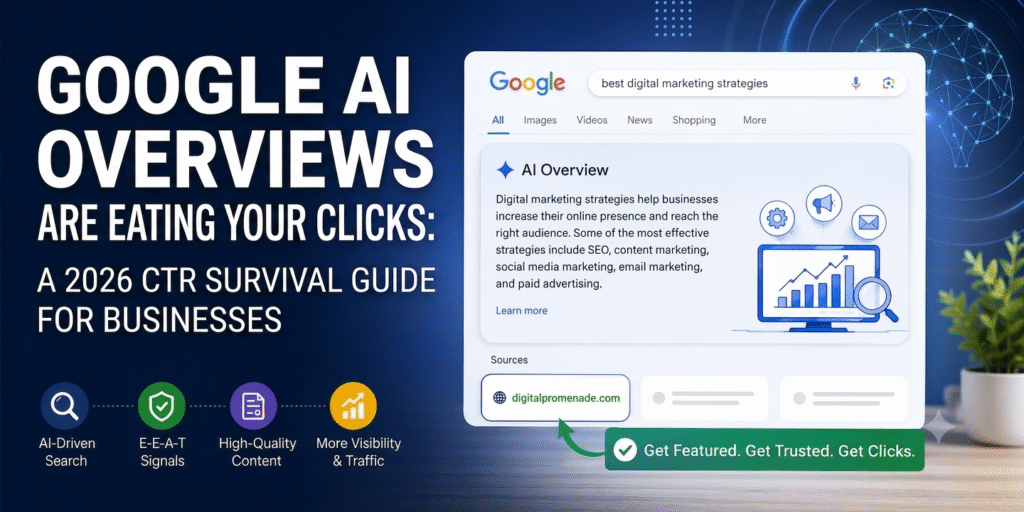
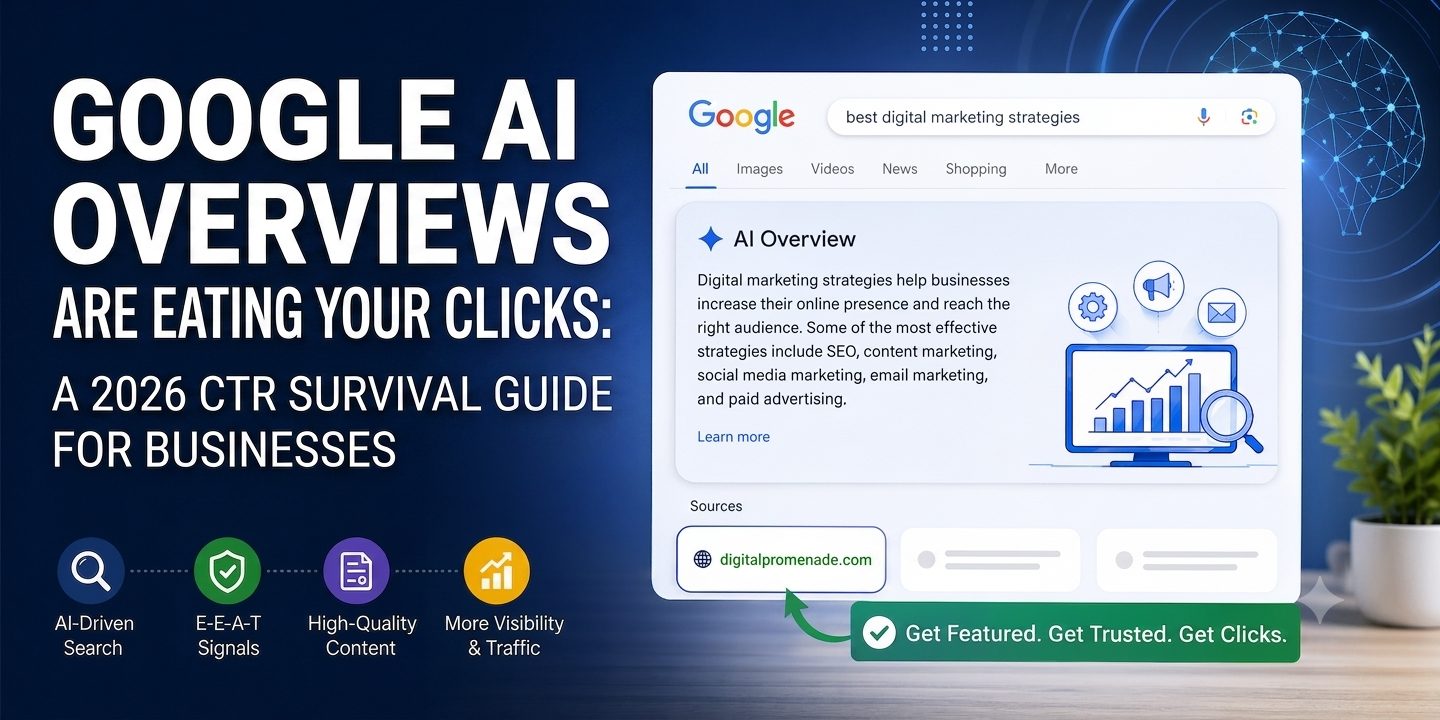
Google AI Overviews Are Eating Your Clicks: A 2026 CTR Survival Guide for Businesses
Digital Promenade
Objective
Google AI Overviews have fundamentally changed what it means to rank on page one. A study of 40,000 BFSI keywords found that average CTR across the top 10 results dropped 36% as AI Overview coverage expanded – with the #1 organic position losing 34% of its clicks. Ranking is no longer enough. You now need to either be cited inside the AI Overview or target the query types where it does not appear.
Key Takeaways
- Google AI Overviews are significantly reducing organic click-through rates (CTR), even for websites that rank on the first page.
- Research shows average CTR across top 10 results dropped by 36%, while the #1 organic position lost over 34% of its clicks.
- Informational queries such as “how-to” and “what-is” searches are the most affected by AI Overviews.
- Transactional, local, and commercial-intent keywords continue to generate stronger click-through rates and remain less impacted.
- Ranking #1 is still valuable, but businesses must now focus on both organic rankings and AI Overview citations.
- Direct-answer content, question-based headings, schema markup, and strong E-E-A-T signals improve the chances of being cited in AI Overviews.
- Content strategies should be divided into click-priority keywords (transactional/local) and citation-priority keywords (informational).
- Monitoring Search Console CTR trends is essential for identifying the impact of AI Overviews on specific keywords.
- Businesses that adapt their SEO strategies for AI-powered search experiences will maintain visibility and traffic more effectively.
- A successful 2026 SEO strategy requires balancing traditional rankings, AI citation opportunities, and conversion-focused content.
Introduction
If your organic traffic has been quietly declining in 2026 despite stable or improving rankings, AI Overviews are likely the reason. I see this pattern repeatedly with clients who come to Digital Promenade after noticing their Search Console shows steady impressions but falling clicks. They are ranking. They are just not getting clicked.
This guide will tell you exactly what is happening, why it is happening, and – more importantly – what to do about it.
What Is a Google AI Overview, and Why Is It Reducing Your Clicks?
A Google AI Overview (previously called SGE – Search Generative Experience) is an AI-generated summary that appears at the top of certain Google search results pages. Google pulls information from multiple sources, synthesises it into a direct answer, and presents it before any organic results appear.
The reason this reduces clicks is structural. When a user searches “how to do keyword research,” the AI Overview gives them a five-step answer with enough detail that many users feel their question is answered. They read the overview and leave without clicking any of the blue links below it. This is what the SEO industry calls a zero-click search.
The impact is not hypothetical. According to research on 40,000 keywords in the BFSI sector, queries where AI Overviews appeared saw CTR fall significantly compared to queries without AI Overviews. The data, published by Techmagnate and aligned with research from Ahrefs, shows a consistent pattern: AI Overviews answer the query well enough that many users do not feel compelled to click through.
Quick Skim: Google AI Overviews appear at the top of search results and synthesise answers from multiple sources, reducing user motivation to click organic results below. This is the primary driver of CTR decline in 2026.
How Much Has CTR Actually Dropped Because of AI Overviews?
Let me give you the specific numbers because vague warnings about “declining clicks” do not help you make decisions.
Research tracking 40,000 BFSI-sector keywords between October 2024 and May 2025 found:
Metric | October 2024 | May 2025 | Change |
Queries with AI Overview | 6.86% | 29.07% | +323% |
Average CTR (top 10) | 5.7% | 3.66% | -36% |
CTR for informational queries | 6% | 4% | -33% |
CTR for transactional queries | 4.42% | 4% | -9.5% |
CTR for #1 organic position | 10.67% | 7% | -34.4% |
CTR for #2 organic position | 7.09% | 4.9% | -30.9% |
CTR for #3 organic position | 4.1% | 3.3% | -19.5% |
The headline finding: AI Overview coverage grew by over 300% in seven months. In the same period, average CTR across the top 10 fell by 36%. The #1 organic position – the most valuable piece of real estate in SEO – lost a third of its clicks.
This is the new reality. Ranking at position one is still valuable, but it is worth approximately a third less than it was in late 2024 for queries where AI Overviews appear.
Quick Skim: AI Overview presence expanded from 6.86% to 29.07% of queries between October 2024 and May 2025 – a 323% increase. In the same period, average CTR for top-10 organic results fell 36%, with the #1 position losing 34.4% of its clicks.
Which Types of Queries Are Most Affected by the AI Overview CTR Drop?
Not all keywords are equally at risk. Understanding the split between informational and transactional queries is critical for making smart keyword decisions.
Informational queries – searches like “how does local SEO work,” “what is a backlink,” “best time to post on Instagram” – are the primary target of AI Overviews. Google’s AI is well-suited to answering factual, explanatory questions, so these queries have seen the highest AI Overview coverage and the steepest CTR drops. Informational query CTR fell 33% in the study period.
Transactional queries – searches like “hire SEO agency Delhi,” “buy Google Ads management service,” “book digital marketing consultation” – have seen much lower AI Overview penetration. Transactional CTR fell only 9.5%, and AI Overview coverage for these queries remains below 1.5% because Google recognises that users want to take action, not read a summary.
The strategic implication is direct: If your content strategy is built primarily on informational content targeting how-to and what-is queries, your organic traffic is going to keep falling as AI Overview coverage expands. You need to build more content around commercial and transactional intent, and you need to make your informational content good enough to be cited inside the AI Overview rather than displaced by it.
Quick Skim: Informational queries are the primary target of AI Overviews and saw a 33% CTR drop. Transactional queries – where users intend to hire, buy, or contact – saw only a 9.5% drop and remain a safer bet for organic traffic in 2026.
Does Ranking #1 Still Matter When AI Overviews Are Present?
Yes, but its value has changed shape.
Ranking #1 still matters because: (a) it gives you the best chance of being cited inside the AI Overview itself, and (b) for transactional and navigational queries where AI Overviews rarely appear, the #1 position still captures a significant share of clicks.
However, the expectation that ranking #1 for an informational keyword will reliably drive large volumes of organic traffic is no longer valid. The new strategic logic is:
For informational queries: Rank #1 to maximise your chances of being cited in the AI Overview as a source. The goal is AI search visibility, not just click volume.
For transactional queries: Rank #1 to capture clicks, because AI Overviews rarely appear here and the #1 position still commands meaningful CTR.
For brand + navigational queries: Rank #1 to protect your brand from competitors appearing above you in AI-generated answers.
The metric that matters most for informational content in 2026 is no longer just CTR – it is whether your brand appears inside AI-generated answers, which is a measure of AI Overview citation optimisation rather than traditional ranking.
For a deeper look at how Digital Promenade’s SEO service integrates AI citation strategy into campaign planning, you can explore that page.
Quick Skim: Ranking #1 still matters, but its value now depends on query type. For informational queries, #1 maximises AI Overview citation chances. For transactional queries, it maximises direct clicks. The two strategies require different content approaches.
How Can You Optimise Content to Get Cited Inside AI Overviews?
This is the most actionable section of this guide. If AI Overviews are going to exist at the top of your target queries, the best response is to become the source they cite.
Here is how to optimise for AI Overview citation:
Write Direct Answers First
AI Overviews pull from content that answers the question directly and early. If a user searches “how long does SEO take to work,” and your article spends three paragraphs on background before saying anything direct, the AI will prefer a competitor who leads with “SEO typically takes 3 to 6 months to show meaningful results.”
I write the direct answer to the target question in the first paragraph or a clearly labelled section near the top of every article. See how I have started this blog with a crux summary – that structure is part of the AI citation strategy.
Use Question-Format Headings
AI systems understand question-format headings as signals that the content directly addresses a specific query. This is also why I have structured this entire article with H2 headings in question form.
Add Structured Data (Schema)
Schema markup helps Google’s AI understand what your content is about. For blog posts and guides, use Article schema. For FAQ sections, use FAQ schema. For how-to content, use HowTo schema. Google’s structured data documentation provides the technical specifications.
Build E-E-A-T Signals
AI Overviews preferentially cite content from sources that demonstrate Experience, Expertise, Authoritativeness, and Trustworthiness. This means: include author credentials, cite data sources, link to authoritative external references, and maintain a consistent publishing history on your topic.
Keep Facts Scannable and Specific
Vague claims like “AI is important for SEO” get ignored. Specific, scannable claims like “AI Overview coverage expanded by 323% between October 2024 and May 2025” get cited. Use precise numbers, concrete examples, and short sentences that an AI can extract cleanly.
Quick Skim: To get cited in AI Overviews, write direct answers at the top of your content, use question-format headings, implement relevant schema markup, build E-E-A-T signals through author credentials and data citations, and use specific facts rather than vague claims.
Which Keywords Should You Target to Avoid the Zero-Click Search Trap?
Building a keyword strategy that avoids the worst AI Overview CTR impact requires targeting the right query types and the right intent signals.
Target these with high priority:
- Transactional keywords: “hire [service] in [city],” “buy ,” “get a quote for [service]”
- Commercial investigation keywords: “best [service] agency in [location],” “[agency] vs [agency] comparison,” “[service] pricing”
- Navigational keywords: brand names, specific product names, unique service identifiers
- Local intent keywords: “[service] near me,” “[service] in [city]” – AI Overviews penetrate local queries less aggressively than informational ones
Approach these with a citation strategy rather than a click strategy:
- Informational how-to keywords: “how to do [task],” “what is [concept]”
- Educational keywords: “guide to [topic],” “explained: [topic]”
- Comparison keywords with educational intent: “difference between X and Y”
For these informational keywords, the goal is not to drive direct organic clicks – it is to become the cited source inside the AI Overview, which builds brand awareness and trust even without a click.
At Digital Promenade, when I build keyword strategies for clients, I now map every target keyword to one of three buckets: high-click-priority (transactional, where CTR remains strong), citation-priority (informational, where being cited in the AI Overview is the goal), and hybrid (commercial investigation queries where both outcomes matter).
Quick Skim: In 2026, keyword strategy requires splitting targets into high-click-priority (transactional, local, brand) and citation-priority (informational, educational). Building content to be cited inside AI Overviews is as important as building content to be clicked on.
How Does Digital Promenade Build AI-Overview-Resilient SEO Campaigns?
At Digital Promenade, I have integrated AI Overview resilience into every SEO campaign from the ground up. Here is what that looks like in practice.
Keyword mapping by intent and AI Overview risk: Every keyword I target for a client is classified by its AI Overview exposure risk. Transactional and local keywords get prioritised for direct traffic capture. Informational keywords get citation-optimisation treatment.
Content structure audit: I audit existing client content to ensure it follows the direct-answer-first structure that AI Overviews favour. Pages that bury their core answer in paragraph four get restructured.
Schema implementation: Every client site gets comprehensive schema implementation – Article, FAQ, LocalBusiness, and HowTo schemas deployed across the relevant pages.
Monthly CTR monitoring: I track CTR by query type and by ranking position monthly in Search Console. If CTR drops on a high-ranking page without a corresponding drop in impressions, it is usually a sign that an AI Overview has appeared for that query. I catch this within the monthly cycle and adjust strategy.
Transactional content expansion: For clients who have historically focused on informational content, I build out commercial and transactional content layers – service pages, comparison pages, case study pages, and location pages – that drive direct-click traffic.
You can see how this integrates with our lead generation service and our core SEO service to build complete campaign structures.
Quick Skim: Digital Promenade’s AI-Overview-resilient SEO campaigns include intent-based keyword classification, content restructuring for direct answers, full schema implementation, monthly CTR monitoring by query type, and strategic expansion of transactional content layers.
CTR Survival Checklist for 2026
Action | Purpose | Priority |
Classify all target keywords by AI Overview exposure | Separate high-click from citation-priority targets | High |
Write direct answers in first paragraph | Improve AI Overview citation chances | High |
Implement FAQ, Article, and HowTo schema | Improve structured data signals | High |
Build transactional content for every informational page | Capture users ready to act | High |
Monitor CTR by ranking position in Search Console monthly | Detect AI Overview appearance early | High |
Add author credentials and data citations to content | Strengthen E-E-A-T for AI citation | Medium |
Create local service pages for location-based queries | Target lower AI Overview penetration | Medium |
Track whether brand appears in AI Overview answers | Measure AI search visibility | Medium |
Build case studies and real-experience content | Differentiate from AI-summarisable generic content | Medium |
Expand commercial investigation content | Capture mid-funnel users before zero-click | Medium |
Frequently Asked Questions
The AI Overview impact on CTR is significant but varies by industry and query type. Research on 40,000 BFSI-sector keywords found a 36% drop in average CTR for queries where AI Overviews appeared. Industries with more informational content - education, healthcare information, how-to content - tend to see larger CTR drops because AI Overviews target informational queries most aggressively. Industries with more transactional queries - e-commerce, local services, B2B lead generation - see smaller CTR drops because AI Overviews penetrate these query types less.
If you run a local service business in Delhi or Noida, for example, queries like "digital marketing agency in Noida" are far less affected by AI Overviews than a query like "how does digital marketing work.
Yes. This is already happening. A page ranking #1 for an informational query that triggers an AI Overview at the top of the SERP will see significantly fewer clicks than the same #1 position would have driven in 2023. The AI Overview answers the user's question before they scroll down to the organic results. This is not hypothetical - it is visible in Search Console data for any site tracking CTR trends over the past 12 months.
Search your target keywords in Google while logged out or in incognito mode. If an AI-generated summary appears at the top of the page, an AI Overview is active for that query. You can also infer it from Search Console data - if impressions remain stable but CTR drops significantly for a specific query, and your ranking has not changed, an AI Overview is likely the cause.
It overlaps significantly but has specific differences. Standard SEO focuses on ranking signals - backlinks, technical health, content relevance. AI Overview citation optimisation additionally requires: direct-answer content structure, specific and citable facts, strong E-E-A-T signals, and schema markup. A site with strong traditional SEO is well-positioned to be cited in AI Overviews, but specific structural adjustments make a meaningful difference.
Much less frequently than for informational queries. Local intent queries - those with a geographic modifier or "near me" - have much lower AI Overview penetration because Google recognises that the user wants a specific local business, not a general answer. This is one of the reasons local SEO remains a high-priority channel for businesses targeting location-specific customers in 2026.
No - but you should change your goals for it. Informational content still drives brand awareness, topical authority, and AI Overview citations. The mistake is measuring it purely on direct click volume. If your informational content is cited in a Google AI Overview, thousands of users see your brand name in the AI's answer even if they do not click. That is a form of visibility that has real value, especially for brand-building in your category.
Conclusion
Google AI Overviews have permanently changed the economics of organic search. Rankings still matter, but they now need to serve two different objectives depending on query type – capturing direct clicks for transactional queries, and earning citation visibility for informational queries. Businesses that adapt their content strategy, keyword targeting, and schema implementation to this new reality will maintain organic visibility. Those that keep optimising for click volume on informational keywords will watch their traffic erode.
If you want a practical plan for making your SEO campaign AI-Overview-resilient, contact Digital Promenade and let me build a strategy that works in the environment that actually exists in 2026, not the one that existed in 2022.
Know Your Digital Goals
Digital Promenade Objective This post breaks down what AI search optimization actually is, how ChatGPT,...
Digital Promenade Objective Google AI Overviews have fundamentally changed what it means to rank on...
Digital Promenade Objective AI agents in SEO are not a future concept – they are...
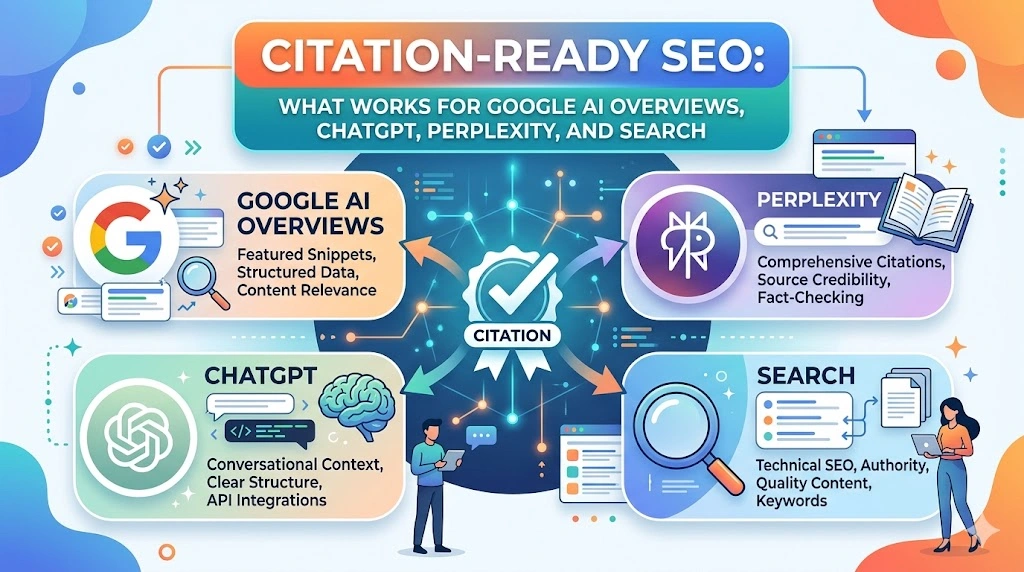
Digital Promenade Objective To get cited in ChatGPT, Perplexity, and Google AI Overviews, build consistent...
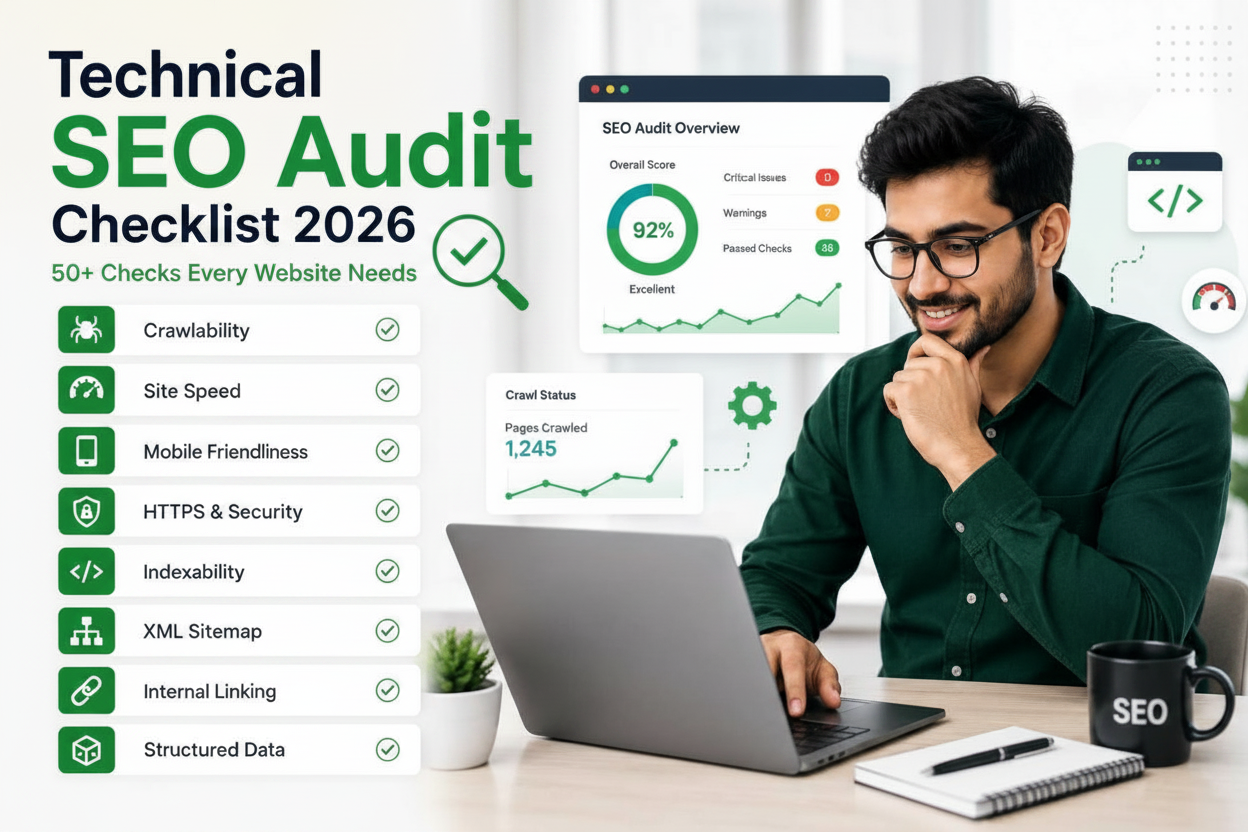
Digital Promenade Objective A technical SEO audit checklist covers crawlability and indexing, site speed and...
Digital Promenade Objective This blog is a practical, step-by-step guide to Google People Card in...

Digital Promenade Objective This blog helps businesses in Noida and Delhi NCR understand what separates...
Digital Promenade Objective This blog explains why SEO is important for B2B companies specifically –...

Digital Promenade Objective This blog explains how SEO and social media can work as complementary...