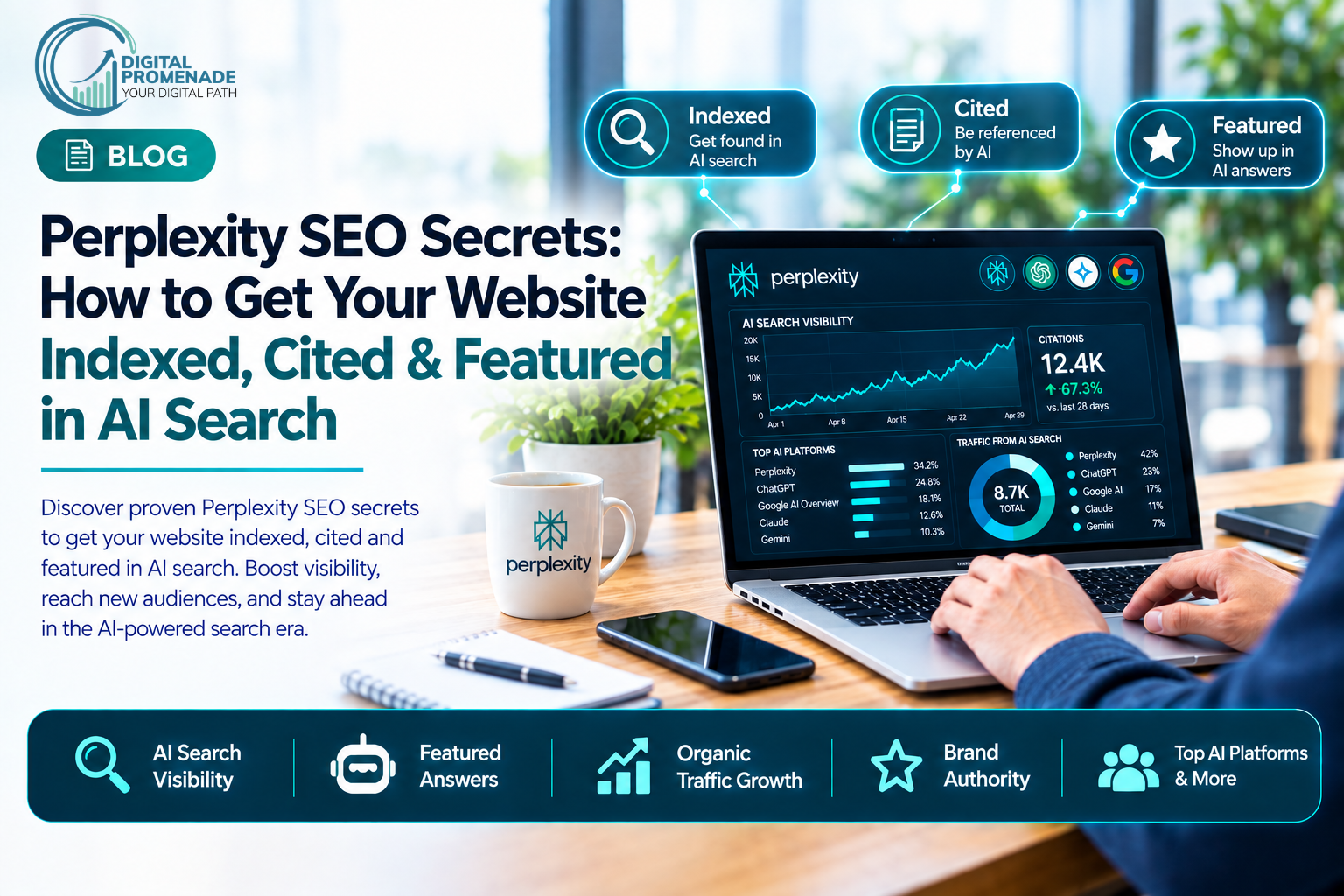
Digital Promenade Objective: Explain exactly how Perplexity indexes, ranks, and cites websites, how that differs...
Proven Methods to Improve Brand Visibility in AI Search
Digital Promenade

Proven Methods to Improve Brand Visibility in AI Search
Objective
This blog helps businesses understand how AI search engines discover, evaluate, and recommend brands — and gives them proven, practical methods to improve their visibility across AI-powered search platforms in 2026.
Key Takeaways
Improve Your Brand’s Visibility in AI Search with Digital Promenade — Starting at $393/Month
Book a Free Consultation — digitalpromenade.com
Something shifted in the way people search for information — and most businesses haven’t caught up yet.
It used to be straightforward. Someone types a query into Google. Google returns ten blue links. The user clicks one. Your job, as a business, was to be one of those ten links — ideally one of the top three.
That model still exists. But increasingly, it is being replaced by something different.
When someone asks ChatGPT which accounting software is best for small businesses, they don’t get ten links. They get a direct answer — a recommendation, with reasoning, often with specific brand names. When someone uses Google’s AI Overview to research a legal question, they get a synthesised response pulled from sources the AI has decided are credible and relevant. When someone searches on Perplexity for the best digital marketing agency in Noida, they get a curated answer, not a list of pages to browse.
This is AI search. And in 2026, it is reshaping how brands get discovered, evaluated, and chosen.
The businesses that understand this shift and adapt to it early will have a significant and lasting advantage. The ones that don’t will find themselves invisible in the very places their customers are increasingly going to make decisions.
This blog is your practical guide to making sure your brand is one that AI search recommends, cites, and trusts.
What Is AI Search and Why Does It Matter for Your Brand?
AI search refers to search experiences that use large language models and artificial intelligence to generate direct, conversational answers to user queries — rather than simply returning a list of links to browse.
The most significant examples right now are Google’s AI Overviews, which appear at the top of many search results pages and synthesise information from multiple sources into a single answer. Then there is ChatGPT Search, which allows users to ask questions and receive researched responses with citations. Perplexity AI operates similarly — it crawls the web in real time and constructs answers from sources it deems credible. Microsoft Copilot is integrated into Bing and does much the same.
These platforms are not replacing traditional search entirely. But they are increasingly handling the high-intent, research-oriented queries where buying decisions get made. When someone is genuinely trying to figure out which agency to hire, which product to buy, or which service provider to trust, they are increasingly turning to AI search to help them decide.
Here is why this matters for your brand: in traditional search, ten businesses appear on page one. In AI search, one or two brands get recommended. The others simply don’t exist in that conversation.
Getting your brand into that recommendation — and keeping it there — requires a different approach to how you build your online presence. Not a completely different approach. But a more deliberate, more authoritative, and more consistent one.
How AI Search Engines Decide Which Brands to Recommend
Before we get into the methods, it helps to understand how AI search models make their decisions.
AI search engines are trained on enormous amounts of text from across the internet. They develop a sense of which sources are credible, which brands are frequently mentioned in relevant contexts, which businesses have a strong and consistent presence in their field, and which content genuinely helps users rather than just trying to rank.
When a user asks an AI search tool a question, the model draws on this training and — in the case of tools like Perplexity and ChatGPT Search — supplements it with real-time web data. It looks for sources that are authoritative, consistent, well-structured, and genuinely useful.
The brands that get recommended are typically those that:
- Are mentioned frequently and positively across multiple independent sources
- Publish consistent, high-quality content that demonstrates expertise in their field
- Have a technically clean, well-structured website that is easy for AI to crawl and understand
- Appear in credible third-party publications, directories, and review platforms
- Have clear and consistent information about who they are, what they do, and where they operate — across every platform they appear on
This is not gaming an algorithm. It is the kind of brand that deserves to be recommended. The methods below show you how to get there.
Method 1 — Build Genuine Topical Authority
If there is one thing that determines whether an AI search engine recommends your brand or ignores it, it is topical authority.
Topical authority means being recognised — by both humans and AI — as a genuinely knowledgeable source on the subjects that matter to your business. Not just knowing a little about a lot of things, but knowing a great deal about the specific topics your ideal customers are asking about.
The way you build topical authority is through depth and consistency of content. This means publishing not just a handful of blog posts, but a comprehensive body of work that covers your subject area thoroughly — from beginner-level introductions to detailed, expert-level analysis.
Think about it from the AI’s perspective. If it is trying to answer a question about local SEO for small businesses in Noida, it will gravitate towards sources that have published extensively and helpfully on local SEO — not sources that wrote one general article about SEO three years ago and haven’t touched the topic since.
This means building a content strategy that is genuinely designed to help your audience understand your area of expertise. It means answering the questions your customers actually ask. It means going deeper than your competitors are willing to go, and updating your content when circumstances change.
Topical authority is not built quickly. But it is extraordinarily durable once established. And in the world of AI search, it is the single most powerful signal you can send.
Method 2 — Optimise for Conversational and Question-Based Queries
Traditional SEO optimization focused heavily on keywords — specific phrases that users typed into a search bar. AI search has shifted the emphasis from keywords to questions and conversations.
When someone uses ChatGPT or Perplexity to research something, they don’t type “best branding agency Noida.” They ask something much closer to natural speech: “What should I look for when choosing a branding agency in Noida?” or “Which digital marketing agency in Noida is best for a growing e-commerce brand?”
Your content needs to match the way people actually talk — not just the way they used to type into a search bar.
This means structuring your content around real questions. It means including FAQ sections that directly answer the questions your audience is asking. It means writing in a way that feels like a knowledgeable person explaining something to someone who genuinely wants to understand — not a list of keywords stuffed into headers.
One of the most practical exercises you can do is to sit down and write out every question a potential customer might ask before deciding to work with you. Then make sure your website, your blog, and your content library answers each of those questions clearly, completely, and in plain language.
AI search models are very good at finding content that answers questions well. If your content does that better than your competitors’, your brand will surface in their answers.
Method 3 — Create Content That AI Wants to Cite
Not all content is created equal in the eyes of AI search. The content that gets cited — that gets pulled into AI-generated answers as a credible source — shares a set of specific characteristics worth understanding.
It is accurate and verifiable. AI models are trained to favour content that makes claims backed by evidence. If you cite statistics, name your source. If you make a bold claim, explain the reasoning behind it. Content that reads as opinion without foundation is far less likely to be cited than content that reads as informed, evidence-backed analysis.
It is structured clearly. AI finds it significantly easier to extract useful information from content that is well-organised. Use clear headings and subheadings. Use short, focused paragraphs. Use numbered lists or bullet points when you are walking through steps or options. Make it easy for both a human reader and an AI crawler to understand exactly what each section is about.
It is genuinely comprehensive. Thin content — short articles that cover a topic superficially and then link out for more detail — is not what AI search is looking for. It wants sources that actually answer the question fully. If someone reads your article and still has unanswered questions about the topic, your article is not comprehensive enough.
It is original. AI models have encountered enormous amounts of recycled, repurposed, and thinly disguised content. What stands out — and what gets cited — is content that offers genuine insight, original perspective, or information that is not readily available everywhere else. Your own client results, your own research, your own professional experience: these are things no competitor can replicate.
It is regularly updated. A blog post published in 2022 and never touched since is not a trustworthy source in 2026. AI search models pay attention to when content was last updated. Keeping your most important content current is not just good practice — it is a direct signal of credibility.
Method 4 — Strengthen Your Brand's Digital Footprint
One of the key ways AI search evaluates a brand’s credibility is by looking at how widely and consistently it appears across the internet. A brand that only exists on its own website is far less credible — in the eyes of both AI and humans — than one that appears in multiple independent contexts.
This is what we mean by your digital footprint: the total collection of places online where your brand exists and is mentioned.
Strengthening it means ensuring your brand appears in relevant directories — Google Business Profile, Justdial, Sulekha, IndiaMART, LinkedIn company pages, industry-specific directories relevant to your sector. It means publishing guest articles on credible industry publications. It means being mentioned in news articles, round-up posts, and third-party reviews.
Every independent mention of your brand across a credible source adds to the picture that AI search is trying to build of who you are and how established you are in your field. A brand that is mentioned in fifteen credible external sources will always rank higher in AI search confidence than one that is only mentioned in one.
This is a long-term play. But it compounds significantly over time, and it is one of the most durable forms of brand authority you can build.
Method 5 — Earn Mentions, Not Just Backlinks
Traditional SEO placed enormous emphasis on backlinks — hyperlinks from other websites pointing to yours. Backlinks still matter. But AI search has introduced something equally important: brand mentions without links.
When a respected industry blog writes about the best branding agencies in Noida and includes your name — even without linking to your website — that mention is a signal. When a satisfied customer leaves a detailed review on Google mentioning your agency by name, that is a signal. When a journalist quotes one of your team members in an article about digital marketing trends, that is a signal.
AI search models pick up on these unlinked brand mentions and use them to build a picture of how credible, how established, and how frequently recommended your brand is within its field.
The practical implication of this is that your PR and outreach strategy needs to expand beyond simply chasing backlinks. Getting your brand mentioned in the right places — even without a link — is genuinely valuable. Contributing expert commentary to industry publications, participating in podcasts and webinars, being quoted in news articles, building relationships with journalists who cover your sector: all of these activities contribute to the brand signal that AI search is looking for.
Method 6 — Optimise Your Google Business Profile
If your business has a local presence — and for most businesses in Noida, it does — your Google Business Profile is one of the most important AI search assets you have.
Google’s AI Overviews pull heavily from Google Business Profile data when answering local queries. When someone asks “which is the best digital marketing agency near Sector 63 Noida,” Google’s AI is looking at Business Profile completeness, review quantity and quality, photo recency, posting frequency, and response rate to reviews.
A poorly optimised or neglected Google Business Profile is a direct and significant handicap in local AI search.
Optimizing it properly means: completing every single field available, including your service categories, service descriptions, business hours, and Q&A section. It means uploading high-quality photos regularly — of your office, your team, your work. It means posting updates to the profile at least once a week. It means responding to every review, positive and negative, promptly and professionally. And it means actively encouraging satisfied clients to leave detailed, genuine reviews.
This is one of the highest-return activities available to any local business trying to improve AI search visibility. It takes time and consistency, but the compound effect of a well-maintained Google Business Profile on AI-generated local recommendations is substantial.
Method 7 — Make Your Website Technically Flawless
AI search crawlers — like all search crawlers — can only work with what they can access and understand. A technically flawed website creates barriers that reduce the likelihood of your content being indexed properly, crawled completely, or cited accurately.
The most important technical factors to address are straightforward, but they are frequently overlooked.
Page speed. If your website takes more than three seconds to load on mobile, you are losing both human visitors and search crawler confidence. Google’s Core Web Vitals have made page speed a ranking factor, and AI search models similarly favour sources that are fast and stable.
Mobile responsiveness. More than 60% of web traffic globally now comes from mobile devices. If your website is not fully responsive — if it requires pinching and zooming on a phone, or if elements overlap and break on smaller screens — you have a fundamental credibility problem.
Clean site architecture. AI crawlers follow links to discover content. If your internal linking is weak, your navigation is confusing, or important pages are buried three or four clicks deep from your homepage, there is a real risk that valuable content is not being crawled or indexed at all.
HTTPS security. Every page of your website should be served over HTTPS. Any page still running on HTTP is flagged as insecure by browsers and treated with less trust by search engines.
No broken links or error pages. Crawling a website full of 404 errors signals poor maintenance and reduces AI search confidence in your site as a reliable source.
None of these are glamorous. But getting them right is foundational, and fixing them often produces visible improvements in search visibility within weeks.
Method 8 — Use Structured Data to Help AI Understand You
Structured data — also known as schema markup — is code you add to your website that explicitly tells search engines what your content is about. It removes ambiguity. Instead of a search crawler having to infer that a page is about a local business, structured data tells it directly: this is a local business, this is its name, this is its address, these are its opening hours, these are its services.
For AI search in particular, structured data is increasingly valuable because it allows AI models to extract precise, reliable information about your brand without having to interpret or guess.
The most important schema types to implement for most businesses are: LocalBusiness schema (for businesses with a physical location), Organization schema (for your brand overall), Service schema (for each service you offer), FAQ schema (for FAQ sections on your pages), Article schema (for blog posts), and Review schema (for testimonials).
Implementing these correctly does require some technical knowledge, but the payoff in AI search visibility is real and measurable. If you work with a digital marketing agency — as we do for all of our clients at Digital Promenade — schema implementation should be a standard part of your technical SEO service.
Method 9 — Build Social Proof That AI Can Find
Social proof — reviews, testimonials, ratings, case studies — is powerful in two separate ways when it comes to AI search.
First, it directly influences whether AI search models recommend your brand. When a tool like Perplexity is evaluating which businesses to surface in response to a query, it looks at the evidence that exists across the internet about whether those businesses deliver on their promises. A business with dozens of detailed, positive Google reviews and published case studies is a much safer recommendation than one with no reviews and no third-party validation.
Second, social proof creates content that AI can discover and cite. A detailed client testimonial published on your website is content. A case study that walks through a client’s problem, your solution, and the measurable results is content. These are exactly the kinds of real-world, evidence-backed pieces that AI search models want to reference when answering questions about what results a business like yours actually delivers.
Building social proof deliberately means asking satisfied clients for reviews consistently — not just once when the project ends, but periodically as the relationship continues. It means publishing case studies regularly and making them specific: actual numbers, actual timelines, actual outcomes. And it means making sure your testimonials appear not just on your website, but on Google, on LinkedIn, and on any other relevant platform where AI search might encounter them.
For AI search in particular, structured data is increasingly valuable because it allows AI models to extract precise, reliable information about your brand without having to interpret or guess.
The most important schema types to implement for most businesses are: LocalBusiness schema (for businesses with a physical location), Organization schema (for your brand overall), Service schema (for each service you offer), FAQ schema (for FAQ sections on your pages), Article schema (for blog posts), and Review schema (for testimonials).
Implementing these correctly does require some technical knowledge, but the payoff in AI search visibility is real and measurable. If you work with a digital marketing agency — as we do for all of our clients at Digital Promenade — schema implementation should be a standard part of your technical SEO service.
Method 10 — Stay Consistent Across Every Platform
This is the method that most businesses underestimate — and the one that is increasingly critical in the world of AI search.
AI search models build their understanding of a brand by aggregating information from across the entire internet. When they encounter your brand name, they are cross-referencing what they find on your website, your Google Business Profile, your LinkedIn page, your social media accounts, review platforms, directories, and any other source where you appear.
If the information across these sources is inconsistent — different descriptions of what you do, different phone numbers, different addresses, different versions of your company name — AI search treats that inconsistency as a credibility signal. Or rather, a lack of one.
Consistency means your NAP details — Name, Address, Phone number — are identical everywhere. It means your brand description says the same thing whether it appears on LinkedIn, on Google, on Justdial, or on your own About page. It means your visual identity is recognisable across every channel. And it means your tone and messaging feel coherent whether someone encounters you through a blog post, a social media ad, or a Google Business Profile post.
This is not just a technical exercise. It is about presenting a coherent, trustworthy brand identity to both human visitors and the AI systems that are increasingly mediating how those visitors find you in the first place.
What Not to Do — Mistakes That Hurt AI Search Visibility
Understanding what works is only half the picture. Here are the practices that actively undermine your visibility in AI search — some of which were once considered acceptable SEO tactics.
Publishing thin or repetitive content. AI search models are remarkably good at identifying content that exists to fill space rather than to genuinely help. Thin articles, recycled content, and posts that say nothing new about a topic do not build topical authority — they dilute it.
Keyword stuffing. Writing content that forces a target phrase into every other sentence may have worked in 2015. In 2026, AI search reads naturally — and unnatural repetition of keywords signals low-quality content, not relevance.
Buying or manufacturing reviews. Fake reviews — whether purchased or solicited from people who haven’t genuinely used your service — are increasingly detectable by both Google and AI search models. When caught, the reputational damage far outweighs any short-term benefit.
Neglecting your existing content. Publishing new content while allowing your existing library to become outdated is a slow but significant problem. AI search models factor in content freshness. An article published three years ago and never updated signals to AI that the information may no longer be reliable.
Ignoring brand consistency. As covered above, inconsistent information across platforms is a direct negative signal. Businesses that have multiple versions of their name, address, or description floating around the internet are working against themselves in AI search without realising it.
Over-optimising for traditional SEO at the expense of readability. Content that reads like it was written for a search engine — rather than for a human — will not be cited by AI search. The best-performing content in AI search is the content that genuinely helps the reader. Readability and authority are not in conflict. They have the same goal.
How Digital Promenade Helps Brands Get Found in AI Search
At Digital Promenade, we have been watching the shift towards AI search closely — and building our clients’ digital strategies around it for the past eighteen months.
Every service we offer is now designed with AI search visibility in mind. Our SEO work includes topical authority mapping, structured data implementation, and technical audits specifically focused on AI crawlability. Our content marketing is built around question-based content strategy, not just keyword targeting. Our reputation management work ensures that the social proof our clients accumulate is visible, credible, and consistent across every platform where AI search might encounter it.
We work with businesses in Noida, across India, in the UK, and in the US — and we bring the same systematic, evidence-based approach to every client’s AI search strategy.
The brands that are building genuine AI search visibility right now are not doing it by finding shortcuts. They are doing it by being genuinely authoritative, genuinely consistent, and genuinely useful to their audience — and then making sure the right technical and strategic foundations are in place for AI to recognise and reward that.
That is exactly what we help our clients achieve.
Book your free consultation at digitalpromenade.com
FAQs
What is AI search and how is it different from regular search?
Regular search returns a list of links for users to browse. AI search generates a direct, conversational answer to a query — often citing specific sources and recommending specific brands. Platforms like Google AI Overviews, ChatGPT Search, and Perplexity AI are the most prominent examples in 2026.
Why is brand visibility in AI search important?
Because AI search is increasingly where high-intent research happens. When potential customers are deciding which business to hire, which product to buy, or which service to use, they are frequently consulting AI search tools. Brands that appear in those answers get the business. Brands that don't, don't.
How does AI search decide which brands to recommend?
AI search models favour brands that have genuine topical authority, a strong and consistent digital footprint, credible third-party mentions, well-structured and accurate content, positive social proof, and technically clean websites. It is less about gaming an algorithm and more about being a brand that genuinely deserves recommendation.
Is traditional SEO still relevant in the age of AI search?
Yes — but the emphasis has shifted. Traditional SEO practices like technical website health, structured data, and building credible backlinks are still important. What has changed is the additional importance of topical authority, conversational content, brand consistency, and unlinked brand mentions. Think of AI search optimization as an evolution of SEO, not a replacement.
How long does it take to see results from AI search optimization?
It varies depending on your starting point. Businesses with a strong existing content library and digital presence may see improvements within three to six months. Building visibility from a weaker starting point typically takes six to twelve months of consistent effort. This is not quick-fix territory — it is long-term brand investment.
What is topical authority and how do I build it?
Topical authority is the degree to which AI and search engines recognise your brand as a credible, expert source on a specific subject area. You build it by publishing consistently high-quality, genuinely helpful content across the full range of questions and topics relevant to your field — and by keeping that content updated and accurate over time.
Does social media activity affect AI search visibility?
Indirectly, yes. Social media activity generates mentions of your brand across platforms that AI search can discover. A strong, consistent social media presence also contributes to the overall digital footprint that AI search uses to evaluate brand credibility. It is not a direct ranking factor in the same way as website content, but it is a meaningful supporting signal.
What is structured data and why does it matter for AI search?
Structured data is code added to your website that explicitly describes your content to search engines and AI crawlers — removing the ambiguity that comes from AI having to interpret your pages on its own. It helps AI understand exactly who you are, what you do, where you are located, and what your content covers, which increases the likelihood of your brand being cited in AI-generated answers.
Can a small business compete with large brands in AI search?
Yes — often more effectively than in traditional search. AI search rewards depth of expertise and genuine helpfulness more than it rewards domain authority or budget. A small business that publishes genuinely expert content in a specific niche, maintains a flawless Google Business Profile, and builds consistent credible mentions can absolutely outperform a larger but less focused competitor in AI search results.
How does Digital Promenade help with AI search visibility?
We build AI search strategies that cover all the key areas: technical SEO and structured data, topical authority content strategy, Google Business Profile optimisation, reputation management, brand consistency across platforms, and digital PR for earned mentions. Every element is designed to work together as a coherent system — not as isolated tactics.
Published by Digital Promenade — Your Trusted SEO & Digital Marketing Partner Noida · London · New York | digitalpromenade.com | operations@digitalpromenade.com
Know Your Digital Goals
Digital Promenade Objective: Break down what Answer Engine Optimization (AEO) actually involves, how to evaluate...

Digital Promenade Objective: Explain what an AI SEO agency actually does differently from a traditional...

Digital Promenade Objective: Explain what AI-ready content actually is, how AI search engines like Google...

Digital Promenade Most “best SEO company in India” lists are built the same broken way...
Digital Promenade Your online reputation is not what you say about your business – it...
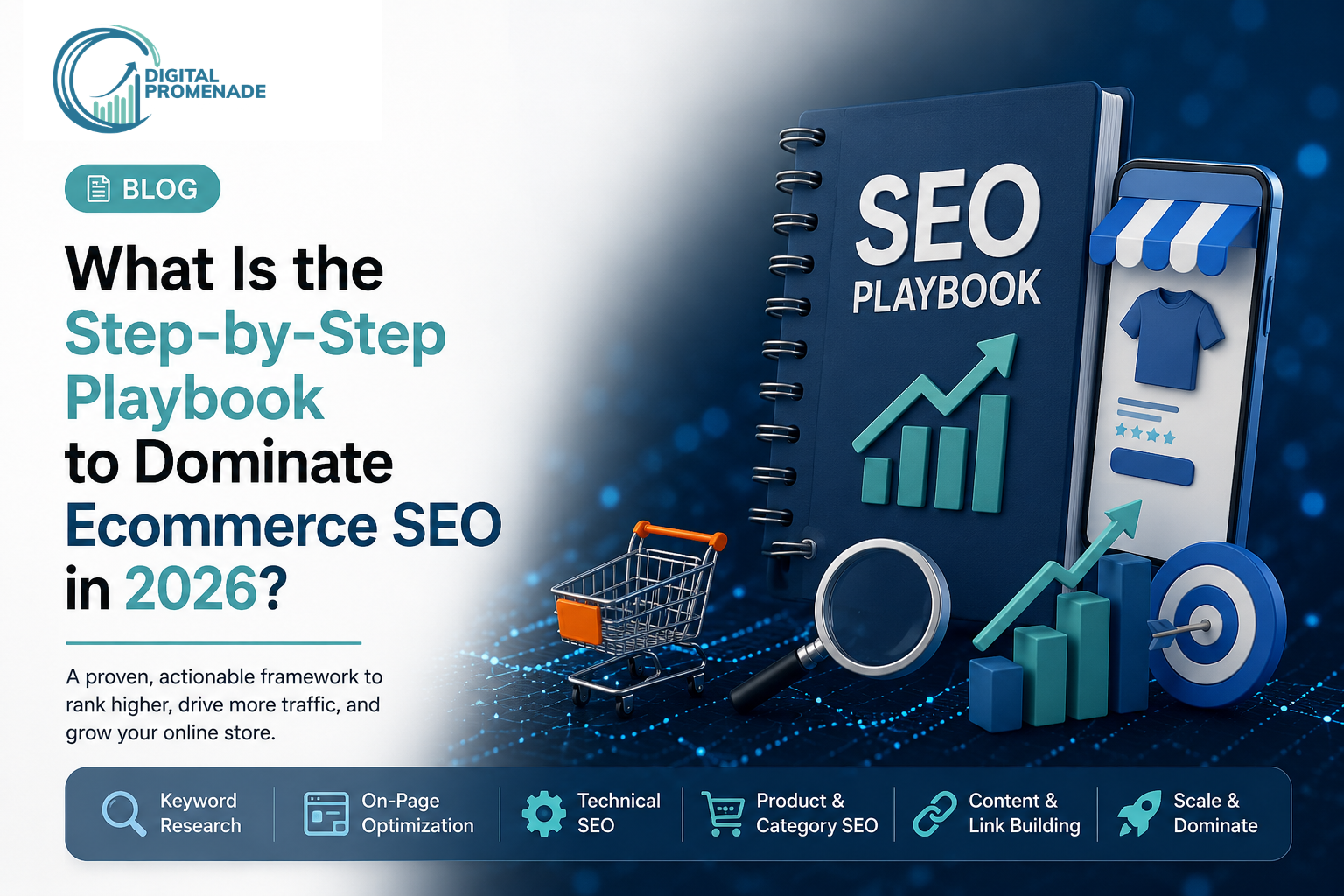
Digital Promenade Ecommerce SEO wins or fails on three things: how easily search engines and...
Digital Promenade Objective This guide shows doctors and medical practices how to build a structured...

Digital Promenade Objective: Explain why running SEO and paid ads as two separate budgets wastes...
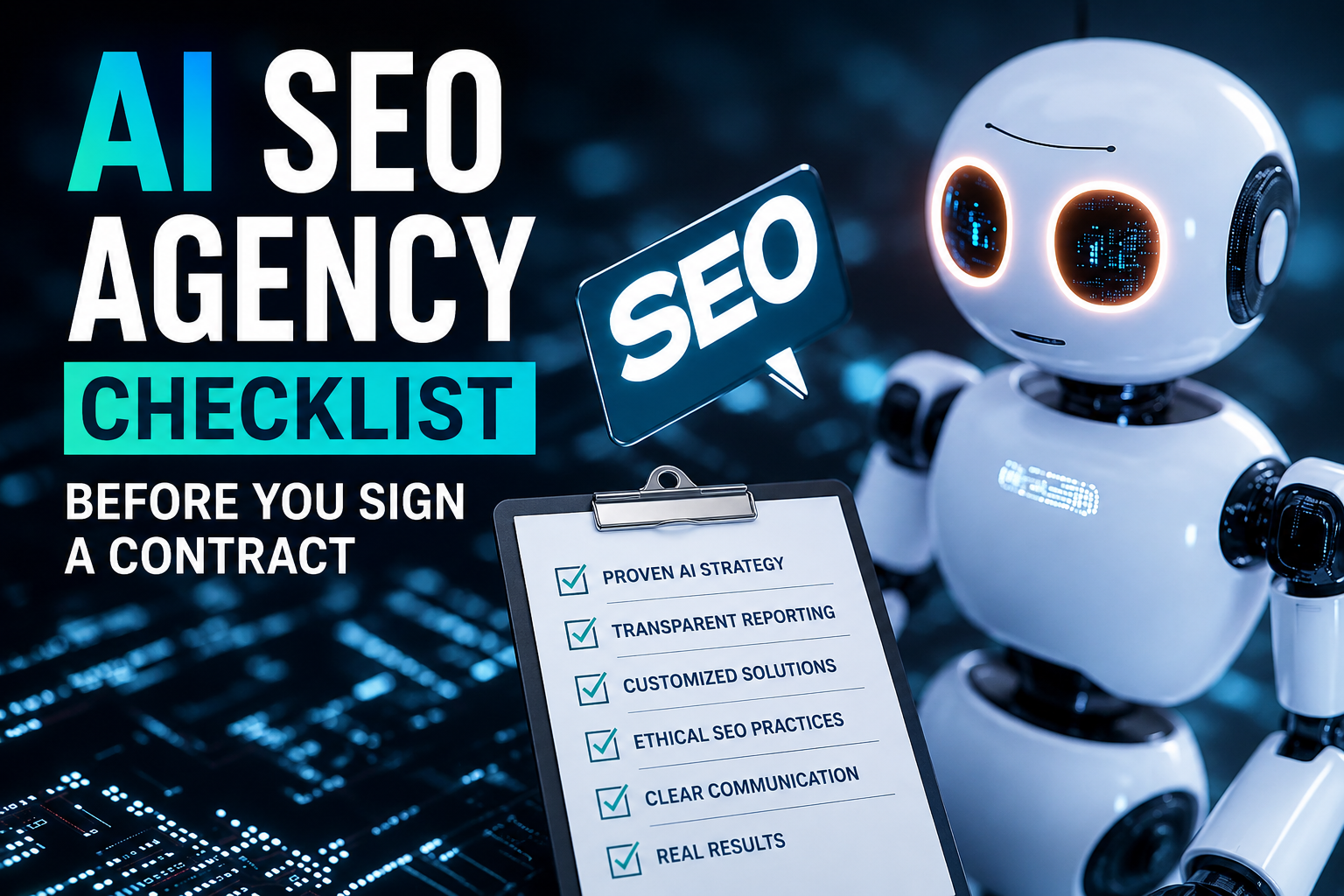
Digital Promenade Objective This post breaks down what actually separates a next-gen AI SEO agency...